
Submitted by City of Westfield
A Westfield Fire Department blood drive on Wednesday, June 3, brought together the people, the program, and the purpose behind one of the department’s most significant advances in out-of-hospital emergency care.
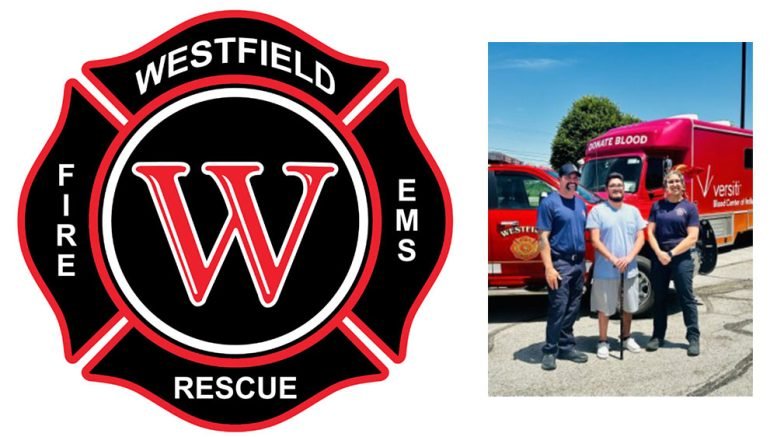
Drake Fuentes, the first patient to receive blood through Westfield Fire Department’s Mobile Blood Response program, was reunited with Tipton Fire Department paramedic Allissa Flick and Westfield firefighter/paramedic Beau Leimbach, who were part of the response that helped bring blood to his side after a serious crash.
The three were photographed together in front of the bloodmobile and Westfield Fire Department’s Field Resource Paramedic vehicle, which carries the department’s blood products and transfusion equipment. Several Westfield firefighters, paramedics and community members also rolled up their sleeves, helping replenish the blood supply that makes programs like Mobile Blood Response possible.
For Westfield EMS Division Chief Patrick Hutchison, the image captured more than a reunion.
“This is exactly why this program matters,” Hutchison said. “It connects the donor, the paramedics and the patient in a very real way. Blood donated by the community can become blood administered by paramedics when someone’s life depends on it.”
Westfield Fire Department launched Hamilton County’s first prehospital blood transfusion program in 2025. The program allows specially trained Westfield paramedics to administer plasma and red blood cells before a patient reaches the hospital.
Plasma supports clotting and red blood cells help restore the body’s ability to carry oxygen after major blood loss. Together, they can be critical for patients experiencing life-threatening hemorrhage from trauma, gastrointestinal bleeding, obstetrical or other medical emergencies.
Blood products are stored between one and six degrees Celsius in a mobile refrigeration unit inside WFD’s quick response vehicle. When requested, the blood is packed into a portable cooler that can be placed into any ambulance receiving support from Westfield’s Mobile Blood Response. The department also carries a blood and fluid warmer and a rapid infuser, allowing paramedics to deliver a unit of blood in about three minutes when a patient needs emergency resuscitation.
Hutchison said the program grew from a change in thinking.
“I used to look at this from a very practical standpoint,” Hutchison said. “We are about 20 minutes from a trauma center and I questioned whether carrying blood was worth the cost, logistics and operational lift. Then I heard a trauma surgeon say a patient’s ZIP code should never decide whether they have access to blood. That changed the way I looked at it.”
Hutchison said Westfield began studying successful blood programs in Indiana and across the country, including South Bend Fire Department, paramedics embedded with the IMPD SWAT team and Vernon Township Fire Department in Fortville. The department also received advice and support from Dr. Lewis Jacobson, director of Ascension St. Vincent’s Level I Trauma Center, as Westfield evaluated how to safely and responsibly bring blood products into the field.
“What we learned is that this is not just about rural EMS or long transport times,” Hutchison said. “A patient can bleed to death close to a trauma center. The issue is not only distance. It is time, access and whether the system is prepared to bring the right care to the patient as early as possible.”
Published research supports early blood product administration for selected patients with life-threatening bleeding. Studies have shown that starting blood products in the field can improve survival for some trauma patients at risk for hemorrhagic shock.
For Westfield, the program is also about regional responsibility.
“We are proud to be the first in Hamilton County, but we do not want to be the only ones thinking this way,” Hutchison said. “If a neighboring fire department or EMS agency has a patient who needs blood, we want them to call us. This program was built to help Westfield patients, but also to support our partners when minutes matter.”
Wednesday’s blood drive also carried a simple message for the community: blood on the ambulance begins with blood from a donor.
Fuentes hoped to donate during the blood drive, but because blood transfusion recipients must wait one year before donating, he was not yet eligible. Instead, he came to support the program, thank the paramedics involved in his care and encourage others to give.
“If it wasn’t for them, I don’t know what my life would be,” Fuentes said.
“That is the spirit we hope catches on,” Hutchison said. “Drake did more than say thank you. He showed up with the intention of paying it forward, and when he is eligible, he plans to donate. Every donor who gives blood is helping put lifesaving care within reach for someone they may never meet.”
Westfield Fire Department encourages residents to donate at future blood drives and support the blood supply that hospitals, trauma centers, and WFD rely on every day.
The next emergency may happen in a home, on a farm, in a neighborhood or on a highway. The blood that helps save that patient may come from someone who simply took time to donate.
To learn more about future Westfield Fire Department blood drives, follow the Westfield Fire Department and the City of Westfield on social media.