

By KEVIN YANEY
For The Reporter
What do these three things have to do with each other: a piece of swamp land in Hamilton County, a North Carolina church, and the Northwest Ordinance of 1787? If you live in Westfield, they are all related to your history.
In 1832, Asa and Susannah Bales relocated from North Carolina to Indiana. They came here with people from their church. They were Quakers who were part of what was known as the Little Quaker Migration that happened throughout Indiana and Ohio from 1820 to 1840.
Why did so many Quakers move to Indiana? Quakers (a.k.a. the Society of Friends) were strict abolitionists. In 1770, the Society came to the decision that they could not be good Christians and own slaves. They required their members to emancipate their slaves to remain a part of the church. Many of these Quakers had settled in the southern coastal states, where the practice of slavery was legal.
In 1820, the Missouri Compromise was passed. This allowed slavery to expand into new southern states as they were brought into the Union. This expansion of slavery caused a stir amongst the Quakers in slave-holding states. They began to search for a new place where slavery was permanently outlawed.
That’s why Indiana became an attractive destination for them.
Before Indiana was a state, it was part of the Northwest Territory. These were lands that were ceded to the United States by Britain after the Revolutionary War. It contained the future states of Illinois, Wisconsin, a portion of Minnesota, Michigan, Ohio, and Indiana. In 1787, the representatives of the Continental Congress unanimously agreed upon the Northwest Ordinance that set up laws to attain statehood and what rights were afforded to residents of the territory, which included the prohibition of slavery in the territory or any state formed from it. This is the last time a legislative body in the United States would vote for total abolitionism until the 13th Amendment, prohibiting slavery, was voted on by the Senate in 1864.
The Bales originally moved to Mooresville, Ind. Two years later, they moved again to Hamilton County. In 1834, Asa Bales, Simon Moon, and Ambrose Osborne founded Westfield. The Bales had been part of the Westfield Monthly Fellowship in Surry, N.C., so they decided to name the town after their church.
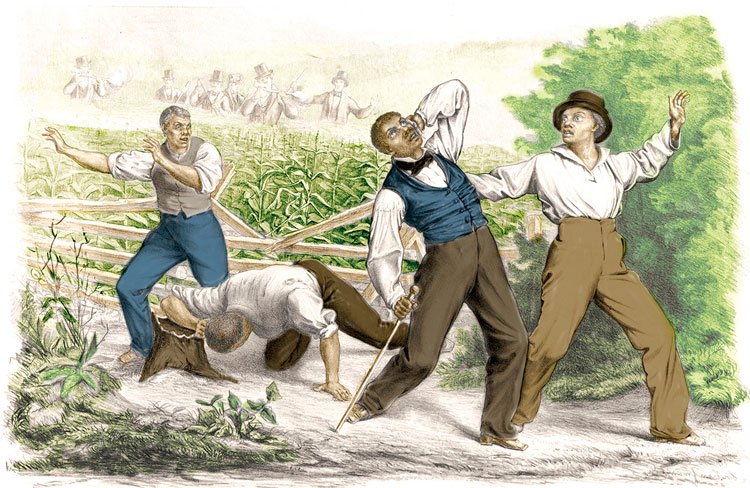
“The Effects of the Fugitive Slave Law.” This is a lithograph from 1850 by Theodore Kaufman. (Courtesy of the Library of Congress)
They settled on a property that was strategically located near a swamp they called the “Dismal Swamp” after the Great Dismal Swamp in northeastern North Carolina. The swamp became a hiding place for fugitive slaves and a deterrent to bounty hunters sent to catch them. Asa Bales and his Friends were not just interested in finding a place where slavery was prohibited; they fully intended to aid runaways passing through central Indiana.
However, there was much unrest in churches over the question of slavery. In the 1840s, many Christian denominations split over the issue, including the Methodists, Baptists, and Presbyterians. The Quakers in Westfield were all anti-slavery, but to what degree would they force their beliefs on others? There was a question whether aiding runaway slaves was the right thing if it violated the law. Asa Bales and others from the Westfield Fellowship saw it as their Christian obligation to give aid and comfort to fugitive slaves. Others saw this as an extreme viewpoint. The Westfield Monthly Meeting split over the issue, which led to the founding of the Anti-slavery Friends Yearly Meeting.
Other abolitionist Christian groups joined together with the Anti-slavery Friends, including the Wesleyan Methodists. In 1843, the Bales sold a plot of land for a church building and a cemetery. Two years later, a cholera epidemic took the lives of Asa and Susannah Bales. They were laid to rest in the Anti-slavery Friends Cemetery in 1845. The cemetery is still there, beside the path in Asa Bales Park in Westfield.
If you want to learn more, on Saturday, June 20 at 10 a.m., Kevin Yaney will lead a tour of the Anti-slavery Cemetery. He will talk about the Underground Railroad and the Civil War in Hamilton County. You can register for the tour at yaney.net/history-tours.