
Early in my life as a disabled person, I heard the term, “token disabled person.” As I got older, I started to understand what was meant by that term, and it was not good.
I did not have any “tools” in my toolbox at that age to give any kind of opinion or rebuttal of such an offensive term. As I usually did, I laughed it off and went to work trying my best to appear as if I were not disabled. I did not know how to advocate to help change the way people treat disabled people. But I do now.
Inclusion is something that disabled people are endlessly advocating for. It should not be this way, but it is, and I fear it always will be. Too often, disabled people are underestimated or instantly categorized solely based on their disability.
I have even heard things referred to as “covering our bases” from employers, or just casually, for example, when someone is discussing a television show or a movie where someone with a disability is a “token character.”
The problem with performative inclusion is that it is fake and really serves no purpose other than an employer or a public institution checking a box. To a disabled person, this is often obvious. Genuine inclusion is felt, not just seen.
Too often, disabled people are expected to be appreciative of haphazardly planned-out, superficial accommodations, rather than changes that are systemic and lasting.
Hotel rooms are a good example of sometimes superficial labeling of accessibility. While the room may offer a couple of minimal accessibility features, labeling the room as accessible is a misrepresentation of reality. Accessible may mean a grab bar by a toilet, or one in a tub/shower combination that is impossible for a wheelchair user to access.
Another example would be a restaurant that has an accessible entrance, but once inside finding out that the bathroom is not accessible, or even up a flight of stairs with no elevator.
Many times, restrooms have the accessible symbol on the outside, but once inside there is not a stall large enough to fit a wheelchair. That is something I experience a lot.
Portable ramps are sometimes offered as a solution to a store that does not have a permanent accessible entrance. In some cases that works out fine, but at other times, the ramp is not stable and does not feel safe. An afterthought, and not a seamless, inclusive experience.
Building an inclusive experience does not happen overnight. It takes research, input from people with various disabilities, and an ongoing effort to make a truly inclusive environment. It is an investment in embracing diversity and sending a message that all lives matter, and everyone should feel welcomed and included.
My husband recently worked on a project at his workplace to help make a more accessible parking lot and entrance to his office building. He asked me for suggestions and relied on his own knowledge through learned experiences with me, what types of accessible features are most valuable. He put a lot of time and effort into this improved accommodation, and the final product is a true reflection of his efforts.
Disabled people deserve to keep their dignity and live their lives in the same way that others do. Exploring and taking part in their communities in an enjoyable way, without wondering where they will use the restroom, or if they will feel welcomed at a store or restaurant.
When I experience a true accessible experience, I make sure to let the establishment know that it is important and appreciated.
One voice does matter. I will keep advocating as long as I can, to ensure that disabled people are not referred to as “tokens” or second-class citizens. More widespread, genuine inclusivity should be a standard practice.
Until next time …
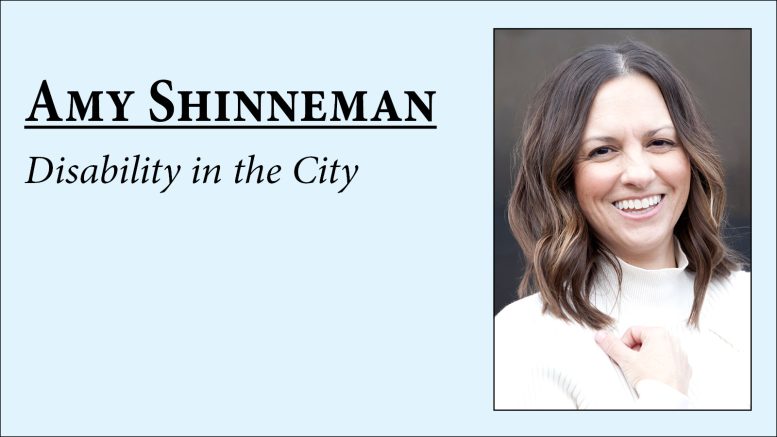
Amy Shinneman is a former National Ambassador for the Muscular Dystrophy Association, disability blogger, freelance writer, wife, and mom of two boys. She is the recipient of The Reporter’s Winter 2025 Ink-Stained Wretch award. You can find her blog at humblycourageous.org and reach her on Instagram @ashinneman.
Another fabulously informative article! Thank you! We need all rhe awareness we can have!