
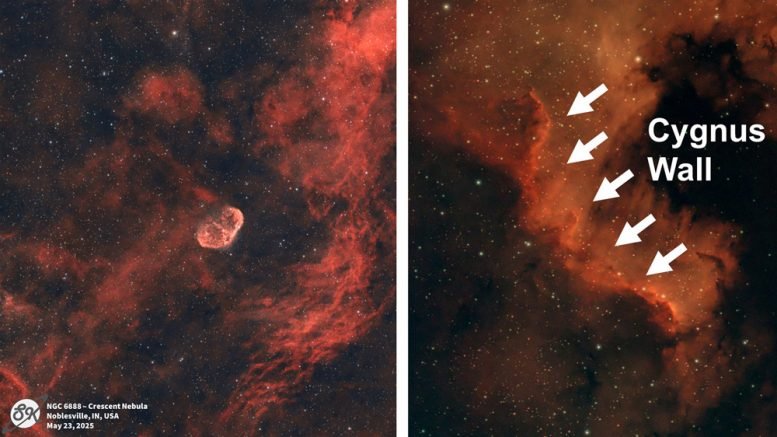
Even in Noblesville you can see galaxies far, far away
By ALEXANDER WEBSTER
alexander@readthereporter.com

Krishnamoorthi
“Being able to see those cosmic objects that are millions and millions of miles away is very, very fascinating for me,” local astrophotographer Sid Krishnamoorthi said.
We often forget just how small we are in the grand scale of the universe. Take our sun; it could fit 1.3 million Earths inside it. Yet it’s only one of an estimated 200 billion trillion stars – that’s two followed by 23 zeros. Even more mind-boggling: about 99.999999999999 percent of the universe is empty space.
Facts like these drive astrophotographer Krishnamoorthi to aim his lens skyward, chasing the beauty and mystery of the cosmos.
“I started this about a year and a half ago,” Krishnamoorthi said. “I picked it up, I think, spring of 2023. That’s when I got my first scope. When I first got it, the main things I looked at were planets and the moon because those are things that you can observe without doing any type of photography.”
To capture photos like Krishnamoorthi does, you’d need special equipment.
“Some of these deep space objects, as they’re called, they’re so faint, especially in Hamilton County, near Indianapolis, we have a lot of light pollution,” Krishnamoorthi said.
 To see deep space objects through the light pollution, you have to take pictures of them. These are not normal photos. They would need hours, even days of exposure time.
“For example, one of the brightest deep space objects is the Andromeda galaxy,” Krishnamoorthi said. “You can see that after maybe just 10, 15 minutes of exposure. But most of the shots that I do in a lot of deep space objects require hours upon hours.”
You may be wondering how you could get into a hobby like this. It’s more accessible than you might believe.
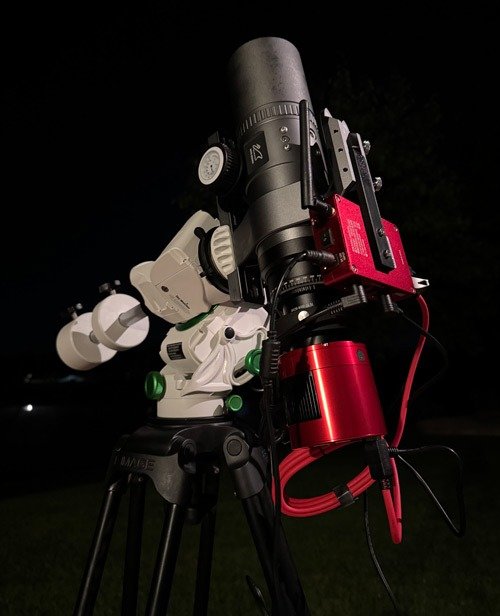
Here is the specialized camera Krishnamoorthi uses to take incredible photographs. (Photo provided by Sid Krishnamoorthi)
“The main thing you need is some kind of automated mount,” Krishnamoorthi said. “It’s called a Star Tracker – or there’s many different names for it depending on the brand. Once you’ve located the object you’re going to be shooting, that mount will actually move with the rotation of the Earth and track that object.”
Tracking the object that is millions of miles away is only one piece of the puzzle; the next is actually capturing it.
“The next big upgrade I did was getting the telescope and the dedicated astrophotography camera,” Krishnamoorthi said. “The reason you need a dedicated astrophotography camera is, as you can imagine, you’re shooting for very, very long periods of time. So what ends up happening is your sensor heats up in the camera and you’ll get really hot pixels which will kind of blow out your image. So these dedicated cameras actually have a cooling system, and they’ll cool the camera down to whatever temperature you set it to be. But if you only have a DSLR, you can get away with that as long as you have a mount that can move with the Earth’s rotation. That’s all you need.”
While astrophotography might not be the simplest hobby to dive into, Krishnamoorthi encourages you to try. If you need some advice, you can reach out to Krishnamoorthi via email at sidkmat@gmail.com.
You can also see examples of his work on Instagram @astrosidk.
Photos provided by Sid Krishnamoorthi