

What Salem has to say about witchcraft and love
By WYNNE BRUBAKER
news@readthereporter.com
How far are you willing to go for the one you love? There might be nowhere better to explore the question than Salem in 1692. Main Street Productions (MSP) will bring Arthur Miller’s The Crucible to the Bastille Westfield Playhouse, 220 N. Union St., Westfield, from Oct. 8 to 18. John Proctor’s struggle to maintain integrity during the Salem witch trials takes center stage in a story so captivating, it might bewitch you.
MSP Director Brent Wooldridge spoke to The Reporter about bringing the story to life.
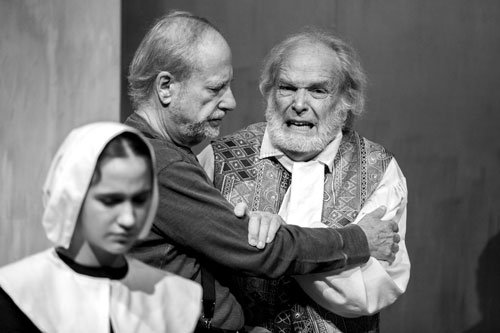
Photo by Zach Dobson Photography
“The story focuses on John Proctor and his wife Elizabeth Proctor,” Wooldridge said. “John Proctor had an affair [with Abigail Williams], but he had stopped it because he was madly in love with his wife. Abigail was hoping to win him back, and what better way to win him back than to accuse his wife of being a witch to get her out of the picture?”
MSP’s play features Duane Mercier as Judge Danforth, which adds more depth to the role because Mercier also played Judge Danforth in high school 40 years ago.
“He brings life experiences,” Wooldridge said. “An actor that’s in high school doesn’t have those life experiences that he can draw from as opposed to somebody that’s pushing 70, that’s done a lot of theater and has developed his craft. He’s been able to bring a lot of depth and nuance to his character.”
Wooldridge’s emphasis on the actors’ understanding of their characters brings authenticity to the performance while fostering a tight-knit community among the cast.
“From the get-go, the cast has really bonded,” Wooldridge said. “They’ve worked really hard, and they’ve helped each other. Early on in the rehearsal process, I would take about 20 or 25 minutes at every rehearsal to discuss the characters in depth. That helped to bring the cast together and to make them have that sense of community.”
The Reporter spoke to three characters as if we were interviewing them in the middle of the story: John Proctor, played by JB Scoble; Abigail Williams, played by Piper Williams; and Judge Danforth, played by Duane Mercier. Keep reading to discover how they truly felt during the Salem witch trials.
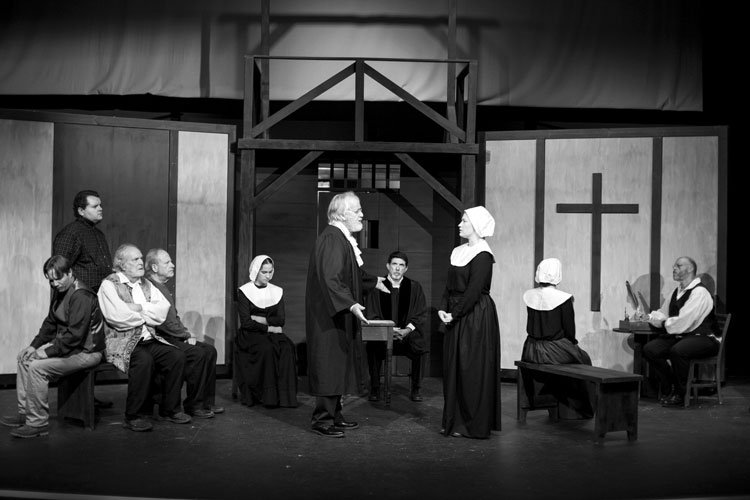
Photo by Zach Dobson Photography
John Proctor
While facing ruthless accusations and suffering under the weight of his guilt, John Proctor told The Reporter when everything went wrong.
“My wife, Elizabeth, got real sick that winter,” Proctor said. “After the birth of our third child, she fell ill. During that time – call it a weak moment while she was ill – I strayed into Abigail’s arms. In other words, I cheated. My wife soon found out. She suspected something was going on between us, and, like a Christian, I confessed my lechery. That was pretty much the blunt end of my relationship with Abigail.”
Although Proctor’s wrongdoing is appalling to any sensible person living in the 1690s, there is no one more distressed by it than Proctor himself.
“I don’t feel like I’m a good man anymore,” Proctor said. “I believe there’s public opinions out there that I might be a good man. I do believe that I could be a better man. This whole situation has caused me to question whether God’s there or not. I’ve changed my life pretty drastically making that choice to pursue the lust and it has definitely changed my opinion of myself in a negative way.”
After Elizabeth discovered the affair, she removed Abigail from the household. The only thing remaining in the Proctor home was a broken marriage. Resentful of Elizabeth for tearing apart her relationship with Proctor, Abigail began to spread rumors of witchcraft.
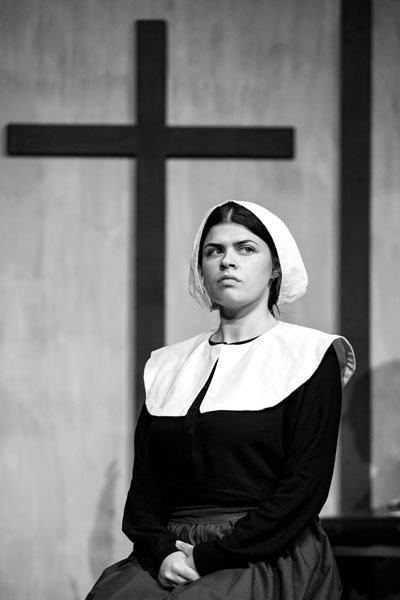
Photo by Zach Dobson Photography
“I really can’t believe anything Abigail does,” Proctor said. “She’s crazy. She needs to hurt my wife, and essentially steal me from my wife. Her intentions are crazy and murderous. She is a wonderful manipulator, she’s a good pretender, she’s a good liar, she’s young and attractive. She’s a leader among her peers, and it can easily sway her friends.”
The court was not spared from Williams’ fabrications, which left Proctor to defend his wife from the community he called home.
“It doesn’t seem like anyone sees me or sees me raising my hand,” Proctor said. “The judges, the magistrates, they’ve been looking at witchcraft for [so much] time, they’re almost blind to when witchcraft might be fraud. The system is a bit twisted: someone says someone [else] says there’s witches, so they’ll find witches. Quite frankly, it’s heartbreaking. The fraud that is before this court is, in my eyes, evil. A lot of good people have died without cause, and my heart breaks for those people – my friends, my friends’ wives, my community, my family. It’s heartbreaking.”
The Reporter also spoke with Abigail Williams, who told a very different version of the story.
Abigail Williams
Williams was caught dancing in the woods in the middle of the night with no explanation, but swears it was not witchcraft.
“What happened in the woods was not witchcraft,” Williams told The Reporter. “We were only dancing when Reverend Parris saw us. I became terrified that I would be punished for what we had done, and I knew if I admitted the truth, I would be blamed. So when I began accusing others, I kept telling that story because it was the only way I could protect myself. Once the court believed me, I couldn’t take it back. I had too much to lose.”
Williams’s and Proctor’s rendezvous was meaningful to Williams, who said Elizabeth was the only barrier to their happiness. With the Salem witch trials still escalating, Elizabeth’s removal was only a matter of time.
Williams eventually told The Reporter what really happened in the woods that night. We leave it to our readers to decide if it was witchcraft.
“The truth is, I want Elizabeth Proctor dead because I’m in love with John,” Williams said. “If she were gone, he could be with me. I did drink chicken blood as part of the charm because I wanted to see her gone. When Reverend Parris had discovered us, I knew I needed to cover that up. [John Proctor] does still have feelings for me, even if he says that things are over. I cannot accept that he would choose her after what we shared together.”
Sometimes, the price of love is paid by many.
“The other girls are afraid because they know what we did in the woods, and they know what would happen if we confess: we would be hanged ourselves,” Williams said. “I made it clear to them that none of them should speak against me, and they know that I will not let them ruin me to save themselves, and they follow my lead because they are frightened about what will happen if they don’t. In the end, it’s what is necessary to be done in order to get what I want.”
Ultimately, Elizabeth’s fate lies in the hands of one person: Judge Danforth.
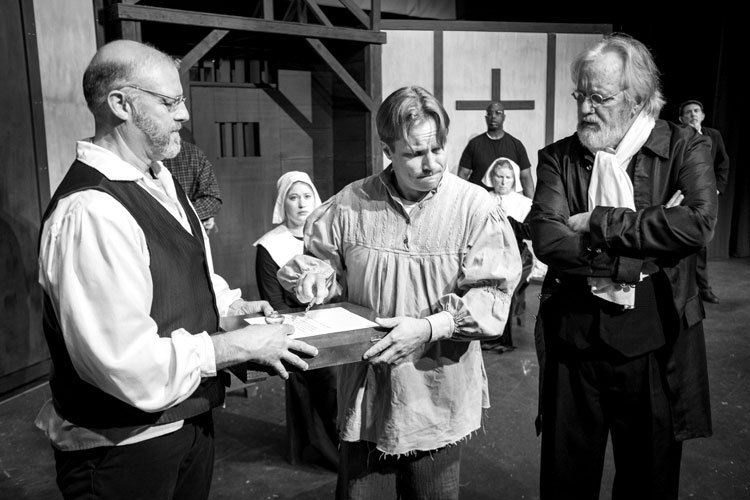
Photo by Zach Dobson Photography
Judge Danforth
In the face of each difficult decision, Danforth said the only reliable option is to turn to God.
“The holy scriptures declare that witchcraft exists, and the court can’t deny what God has made known,” Danforth told The Reporter. “Our law is based upon the Bible, and the Bible was written by the Almighty God. To dismiss witchcraft would be to dismiss the law upon which Salem and indeed the entire province stands.”
Danforth’s role inherently impacts the future of Salem, which is not a responsibility Danforth takes lightly.
“As the deputy governor, it is my responsibility to read through the testimony and direct the rest of the staff to come up with a just verdict,” Danforth said. “God put me on the earth for this very purpose, and it is my destiny to uphold God’s law, to protect the innocent, to purge the community of corruption and of the presence of the devil. I can’t allow sympathy, friendship, or fear to interfere with that justice, so I must preserve order even when doing that demands punishment.”
After Williams brought forth Elizabeth’s name, Danforth had no choice but to eliminate the supposed evil.
“Abigail and the other children were all at the same time afflicted and overcome by the devil in various ways,” Danforth said. “The fact that not only Abigail but the other children are also afflicted in the same manner [is incriminating]. We are guided by the divine hand of God, and we must always assume that God is going to lead us into the right decision. I have every confidence that God will guide us to that just judgment.”
To see how the events will play out, The Crucible stages from Oct. 8 to 18 at Bastille Westfield Playhouse, 220 N. Union St., Westfield. Visit BasileWestfieldPlayhouse.org/showstickets to purchase tickets.

Photos by Zach Dobson Photography
Be the first to comment on "Did the Devil make her do it?"