

By DANIEL SHOCK
A Seat on the Aisle
She did it.
Not much of a spoiler. In Sophie Treadwell’s 1928 expressionist drama Machinal, the murder is never the mystery. The real question, one that feels eerily contemporary nearly a century later, is how an ordinary woman becomes so suffocated by the machinery of work, marriage, and social expectation that violence begins to look like freedom.
I’ll confess: the first half left me uneasy, and not in the good way. The dialogue felt mechanical, the pacing relentless, the repetitions almost unnatural. Then the second half began, and suddenly the discomfort made sense. The unease wasn’t a flaw; it was the point. For a time, the audience isn’t simply watching Helen’s story. We are trapped inside her head.
That sensation is reinforced by the design. Kai Harris’ circular stage, emblazoned with gear imagery, is a literal reminder that Helen’s world is governed by machinery, social and economic. Minimal furniture and tall movable panels keep the environments abstract as scenes shift fluidly between office, bedroom, and prison. Aaron Burns’ lighting projects a ticking gear across the floor, time itself advancing in rigid increments. And the steeply curved seating of Shelton Auditorium wraps the audience around the playing space like a tribunal, so that by the courtroom scenes, we realize we’ve been the jury all along.
Director Marcia Eppich-Harris frames the story as memories flashing through Helen’s mind in her final moment before execution, a concept that fits the play’s dreamlike, episodic structure beautifully. As Helen, Alaine Sims carries the evening with impressive control, tracing the tightening vise of expectation without melodrama. Brant Hughes brings relaxed charm as her lover, a role originated on Broadway by a young Clark Gable.
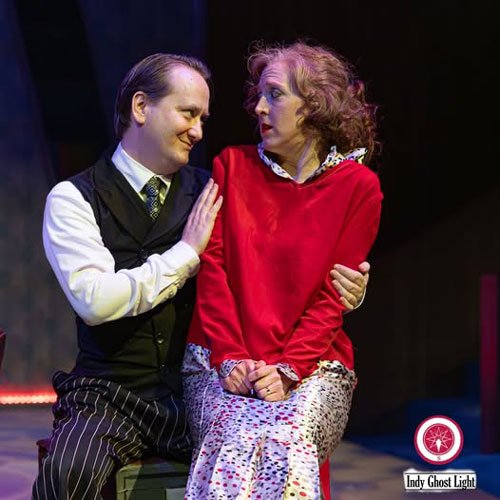
Alaine Sims as Helen with her boss and soon-to-be husband, played by Patrick Vaughn. (Photo by Rob Slaven / IndyGhostLight.com)
Natalie Beglin’s rapid-fire switchboard operator is a comic highlight, while Beverly Roche’s quietly resigned mother offers a grounded counterpoint. Patrick Vaughn moves convincingly through the key authority figures in Helen’s life, her boss, her husband, and her lawyer, each one recognizable and oppressive in equal measure. J. Charles Weimer brings period authenticity to his several roles throughout the evening.
Both Nia Hughes, whose lovely singing moments add unexpected lyrical texture, and Adriana Menefee bring warmth and versatility to the ensemble, helping flesh out the social world pressing in on Helen from all sides. Together the cast creates a vivid, cohesive machine around the Young Woman, every character another cog tightening against her.
Nearly a century after its premiere, Treadwell’s play still hums with unsettling relevance. Southbank Theatre Company’s production is a powerful reminder that some theatrical machines never stop turning.
We may begin the play knowing she did it. What still lingers is the more unsettling question Treadwell leaves us with: why?
Southbank Theatre Company’s Machinal continues at Shelton Auditorium at Butler University through March 22. Tickets and information are available through Southbank Theatre Company’s website, southbanktheatre.org.
Content advisory: The production includes a brief scene of sexuality and moments of flashing lighting effects that may affect photo-sensitive audience members.
Read more great play reviews from A Seat on the Aisle at asota.wordpress.com.