
No one denies the power of words, either written and spoken. We are struck mesmerized by a thundering speech. Our souls are stirred. We may cheer. We may cry.
All faith traditions recognize the power of words. A good friend of mine often talks about the consequences of “putting that on the wind.” It seems as though the sole act of speaking has a way of molding reality itself.
This is written in the Bible, wherein Genesis God literally speaks all of reality into existence. Regardless of your beliefs, what an extraordinary illustration!
Consider this: what if our understanding of the power of words is the direct result of the fact that reality was and continues to be spoken into being?
Maybe it’s not just that words can have power. Maybe it’s that words are power.
Maybe that’s why we hold the concept of free speech so dear. Maybe it’s not only a constitutional right.
Maybe it’s fundamental to our existence.
You see, I think that means when a person is murdered for speaking, what’s really going on is an attempt to stop creation itself. It’s a single-minded force of destruction without consideration of consequence.
It’s another example of what I’ve said previously: You know Evil when you see it.
I’ll take it a step further.
It’s an attempt to murder God.
Then what?
In Friedrich Nietzsche’s 1882 book The Gay Science, he made famous the phrase “God is dead.” Nietzsche was in no sense a Christian; in fact, he held deep disdain for Christianity.
As always, however, context is crucial. The full passage – Aphorism 125, “The madman” – describes a man running into a marketplace yelling, “I seek God! I seek God!” He is surrounded by nonbelievers who laugh at him and mock him. When he realizes this, he condemns them, saying:
“Whither is God? I will tell you. We have killed him – you and I. All of us are his murderers. But how did we do this? How could we drink up the sea? Who gave us the sponge to wipe away the entire horizon? What were we doing when we unchained this earth from its sun? Whither is it moving now? Whither are we moving? Away from all suns? Are we not plunging continually? Backward, sideward, forward, in all directions? Is there still any up or down? Are we not straying as through an infinite nothing? Do we not feel the breath of empty space? Has it not become colder? Is not night continually closing in on us? Do we not need to light lanterns in the morning? Do we hear nothing as yet of the noise of the gravediggers who are burying God? Do we smell nothing as yet of the divine decomposition? Gods, too, decompose. God is dead. God remains dead. And we have killed him.”
Then everyone is silent. No words to offer with no Creator to inspire them.
As it turns out, the madman has come to warn the people of the consequences of their murderous actions, but he realizes that no one is ready to hear what he has to say.
Although quite anti-Christian, Nietzsche understood the foundational importance of Christianity in Europe and he worried about the effects of what he saw as its coming collapse, even in the 19th century.
He died in 1900 aged 55, catatonic from strokes and vascular dementia. Imagine if he had seen any of the horrors of the 20th century.
You see, we’re once again faced with the consequences of what happens when speech is silenced. You may think I’m hyperbolic to make this connection between silencing speech and the death of all Creation itself.
I don’t care.
It is incumbent upon us all to speak truth loudly, with purpose, with conviction, and without apology.
But none of us is permitted to murder another person for his or her words.
All we can do is forcefully insist on speaking, even when dangerous to do so.
It’s not a question of whether you should.
It’s a command that you must.
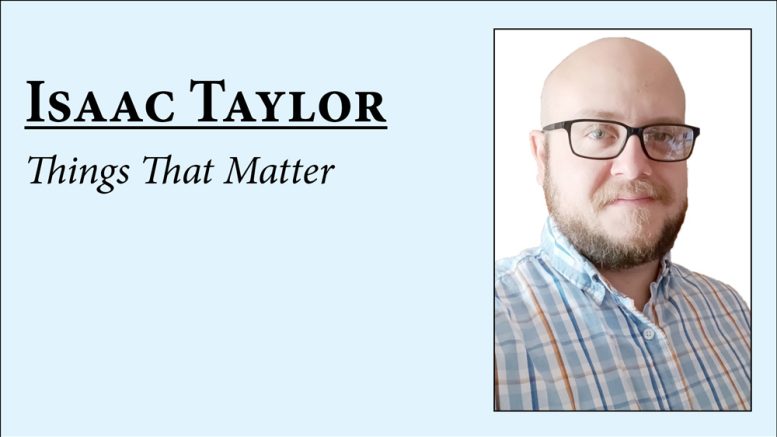
Isaac Taylor is one of the owners of the Hamilton County Reporter, as well as the circulation director and page designer. You won’t find him anywhere online, so don’t bother looking.