
ક્યારેક જીવનના સૌથી મજબૂત વચનો, સૌથી નાજુક દોરાથી બંધાય છે.
Sometimes, the strongest promises in life are tied with the most delicate threads.
Growing up in India, Raksha Bandhan was one of those traditions that brought the whole family together.
Raksha means protection. Bandhan means a bond, a connection, a knot.
On this special day, a sister ties a rakhi, a sacred thread, around her brother’s right wrist. She offers prayers and blessings for his long, healthy, and fulfilling life, and wishes for his dreams to come true. In return, the brother promises to stand by his sister, to be there through thick and thin, to support her through life’s challenges and to protect her through whatever hurdles may come her way.
But as I look back on those childhood celebrations, I realize the rakhi was only one part of the story.
There was always a mother behind the thread.
Our mother made sure that the promise between siblings did not end when the celebration was over. She reminded us to look out for one another, to share, to help, to forgive, to check in, and to show up.
Sometimes she had to remind us more than once.
That is what mothers do. They don’t simply teach us to love our family; they teach us that love comes with responsibility.
The promise of Raksha Bandhan was never just, “I will protect you.” It was also, “I will be accountable to you.”
As children, we may not have understood that lesson fully. But year after year, that sacred thread became a gentle reminder that we were connected and that being connected meant taking care of one another.
Today, as a mother of two girls, I see that same beauty unfolding in my own home.
I watch my daughters learn to support each other, encourage each other, and become each other’s biggest cheerleaders. My hope is that they will continue to hold one another accountable – not through judgment, but through love.
Perhaps that is where the meaning of Raksha Bandhan can grow beyond our homes.
If a mother can teach two children to care for each other, can a community do the same?
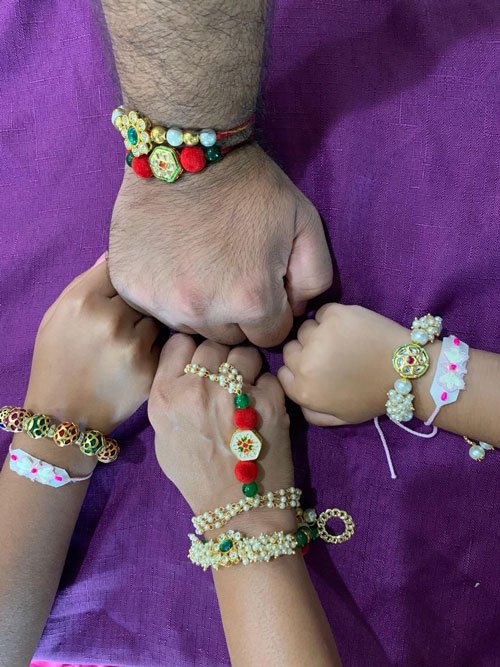
Photo provided by Pooja Thakkar
Can we become the person who checks in? The mentor who says, “I believe in you.” The neighbor who shows up when someone needs help. The friend who reminds us of our commitment when we lose sight of it.
The community member who makes sure someone who feels unseen knows that they belong.
For several years, the Indian and Hindu community in Indianapolis has celebrated Raksha Bandhan as Universal Oneness Day, extending the meaning of the sacred thread beyond the traditional brother-sister relationship.
The spirit is simple: we can choose to care for one another. When people from different faiths, cultures, languages, and traditions come together around that idea, Raksha Bandhan becomes more than a cultural celebration. It becomes a universal message.
That is the beauty of unity in diversity.
Our differences do not need to be erased for us to belong together. We do not have to worship the same way, speak the same language, follow the same traditions, or come from the same place to recognize something deeper: we are one human family.
Perhaps that is the larger meaning of Raksha Bandhan.
The thread around the wrist is a symbol. The real bond is the responsibility we carry in our hearts. I see you. I respect you. I care about you. Your well-being matters to me. And despite our differences, I will stand with you.
At home, my mother taught me that a promise means showing up for family. Today, I believe that lesson belongs to all of us because our community is simply a larger family, and our human family is larger still.
Diversity need not divide us. Oneness need not require sameness.
A small thread can hold a very big promise.
દોરો નાનો, બંધન વિશાળ.
A small thread, an expansive bond.
May we carry that promise beyond Raksha Bandhan, not just around our wrists, but into the way we live, lead, mentor, serve and care for one another. One thread. Many traditions. Many stories. One human family.
That is how a promise made at home becomes a commitment to humanity.
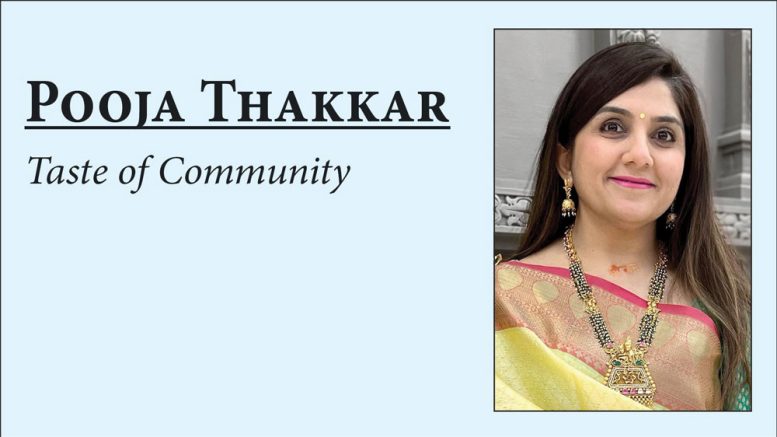
Pooja Thakkar is working to build cultural connections. You can read her column each week in the pages of The Reporter.
Be the first to comment on "Raksha Bandhan: from one thread to one human family"