
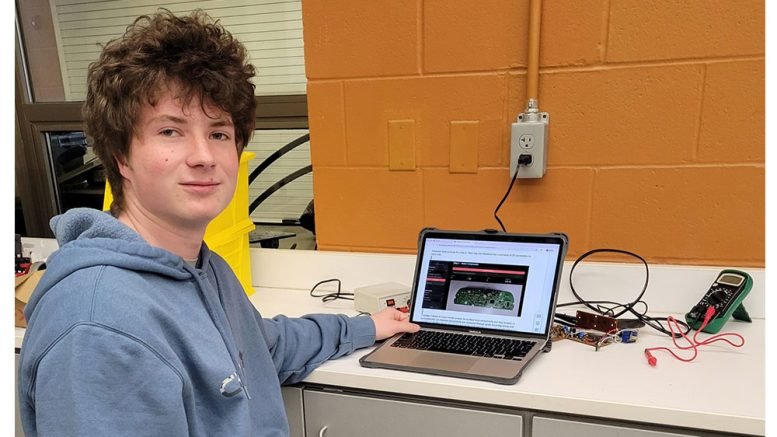
Submitted by Hamilton Heights School Corporation
An extraordinary team effort from Hamilton Heights administrators, educators, and legal partners created the opportunity for Hamilton Heights High School student Alexander Weiland to successfully file a provisional U.S. patent on Friday, March 6 for an innovative engineering tool he developed as part of a classroom project.
The patent filing marks a significant milestone for Weiland, whose work began in the high school’s engineering classroom taught by Dave Post. Students were challenged to identify a real-world problem, design and test a solution, refine it through iterative development, and build a business case around their idea.
Weiland asked to pursue a concept he had been thinking about long before the assignment, and with teacher support, he was encouraged to bring that passion into the classroom.
What followed was a remarkable display of student initiative, technical skill, and perseverance. Weiland wrote extensive lines of code, built detailed part-file libraries, and conducted deep research to bring his idea to life. His final product, the TraceAI Reverse Engineering Analysis Tool, uses artificial intelligence to dramatically reduce the time and cost associated with reverse-engineering printed circuit boards (PCBs).
- The Problem: Reverse-engineering a PCB typically requires 20 to 40 hours of manual tracing by engineers. The process is slow, expensive, and requires specialized tools.
- The Solution: TraceAI analyzes a photo of any PCB and automatically generates a schematic, component list, and netlist in minutes. Users simply upload an image, no specialized hardware required, and the tool provides the design information needed to reproduce the PCB.
“My provisional patent is for an AI system that can reverse engineer PCBs from photos,” explained Alexander Weiland of the innovation behind his patent. “You take a picture of a circuit board and the software automatically figures out what components are on it, traces all the connections, and delivers a full schematic. The main inventions are a pipeline that combines multiple AI models for better accuracy, and an engine that reconstructs the actual circuit logic just from the image.”
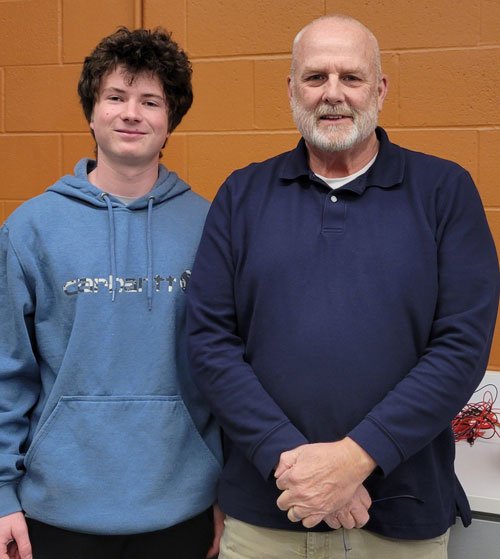
HHHS junior Alexander Weiland and engineering teacher Dave Post share a moment of pride as Alexander’s TraceAI project – developed in Post’s class – earns a provisional U.S. patent and advances to the STARTedUP Region 2 Finals at Purdue University. (Photo provided by Hamilton Heights School Corporation)
Weiland’s TraceAI web application project was entered in the STARTedUP statewide entrepreneurship competition, where his project has now advanced to the Region 2 Finals at Purdue University on April 16.
The rapid turnaround from idea to provisional patent was made possible through swift collaboration. The initial outreach to legal counsel occurred on Feb. 24, and within two weeks, barriers were removed and the path cleared for Weiland to file.
Weiland, who is already looking ahead, said, “I want to turn my patent and idea into a technology startup. The goal is to make an integrated tool that hobbyists, engineers, and companies can use when they’ve lost documentation, want to understand how a product works, or analyze a competitor’s product. I’m building out the AI training pipeline now and getting feedback from engineers. I will continue developing and improving upon my idea and hopefully it becomes a real product people can use in the next year or two.”
Reflecting on the classroom experience that sparked this achievement, he shared, “This was always something I wondered if I could pull it off, so getting it working was really fun. I like working on stuff that’s challenging, and doing it during school time is even better. My engineering teacher gave me lots of good feedback, and I did most of the coding outside of school, which honestly gave me more freedom to experiment.”
For Weiland, the biggest thing he took away is that you don’t have to wait until everything is perfect to start.
“The patent process made me think about what sets my idea apart, and going through that actually refined the idea itself,” he said. “Building something real from an idea that you have is a great experience, and I’d recommend it to anyone.”
“I want to say a huge thank you to the patent attorneys, Todd Coffeen and Joel Tragesser, for their expertise,” he added. “I also want to thank my engineering teacher, David Post, and the Hamilton Heights Administration for supporting my patent efforts and giving me the space to pursue this.”
Hamilton Heights celebrates Weiland’s achievement and extends gratitude to the administrators, educators, and legal partners whose support made this milestone possible. This accomplishment reflects the power of student-centered learning and the extraordinary potential unlocked when passion meets opportunity.