
By JERRY BUCHANAN
Editor’s note: Mr. Buchanan’s story of St. Charles, Va., bears importance to Hamilton County as numerous people moved to Noblesville for work at the Firestone plant. According to Buchanan, this migration for work is the reason why so many former Lee County residents still live in the Noblesville area today.
When I close my eyes and think of St. Charles, Va., I don’t see the sleepy, almost vanished crossroads it is today. I see the ghosts of its roaring past. I see the dust rising from a booming coke operation and smell the coal and wood smoke from the fireplaces and cooking stoves and hear the train whistles echoing in front of my house.
For those of us who grew up in St. Charles, a short drive from Pennington Gap, St. Charles is more than a map point – it’s a story of ambition, a rise, and a devastating fall, perfectly encapsulated in the phrase that describes its life: “Bargersville Author Traces the Tragic History of His Virginia Hometown, St. Charles.”
The Boomtown: Fueled by Coal, Serving the Camps (1900-1930s)
The ambition was formalized on Jan. 10, 1914. With the coal boom in full swing and nearly 300 residents, the community successfully petitioned the Lee County Circuit Court to become an incorporated town. This was the pinnacle of its Boomtown era. The wealth of the surrounding Appalachian seams, mined by companies like Stonega Coke and Coal, fueled an engine of commerce.
Crucially, St. Charles served as the central hub for a constellation of nearby mining settlements – true company towns – that included names like Bonny Blue and Benedict. While the miners used raw coal and wood stoves for heating and cooking in their camp homes, St. Charles was the center for civic life and commerce. On Saturdays, the sidewalks were so crowded with miners and their families commuting from the hollows that the atmosphere felt electric. The rhythm of the town was set by the Southern Railway’s St. Charles Branch, which connected this remote corner of Lee County to the industrial world.
The Ghost Town: The Slow, Quiet Decline (1940s-2000s)
The vitality of the Boomtown era proved to be unsustainable. The decline began not with a disaster, but with a slow, grinding industrial shift. As coal companies introduced mechanized mining and depleted the most accessible seams, the need for a massive workforce vanished. The resources that created the town had finally begun to abandon it.
The effects were visible first in the surrounding camps and then in St. Charles itself. From a population peak of 550 in the 1950 Census, families began seeking work elsewhere, migrating to cities or other states. The businesses that defined the town slowly shuttered; the school closed; and the sidewalks emptied. St. Charles entered its decades-long phase as a Ghost Town, a community whose population still lived there, but whose lifeblood had quietly drained away.
The No Town: The Quiet Termination of a Century (2000s-Present)
The slow decline became irreversible in the 21st century. The population dwindled to just 73 residents by the 2020 Census. The most telling sign of the end was the quiet failure of its local governance: for years, town council seats went unfilled. The community had ceased to function as a municipality.
The final act arrived in 2022, when the Virginia General Assembly formally terminated the town’s charter. The official end came not with a bang of industry leaving, but with the quiet stroke of a pen, closing the book on the town that incorporated with such optimism 108 years earlier.
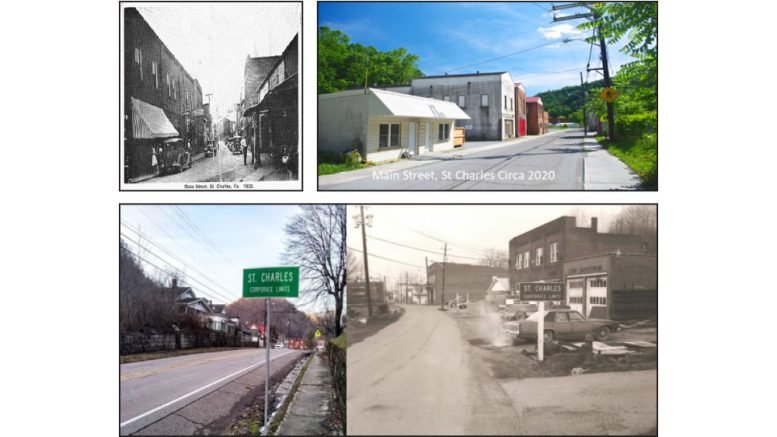
The stark visual reality of this journey is best seen in photographs. The contrast between the bustling commercial scene in 1920 – packed with people and promise – and the desolate frame of 2020 speaks volumes. Today, the town is reduced to a few scattered homes and buildings, including the essential Community Health Clinic and the adjacent Black Lung Clinic, a powerful, lingering testament to the health costs of the resource that created the town.
The two faded road signs, which once proudly announced the town’s limits, are now the final, silent sentinels of a community. The signs – one marking the lower entrance and one the upper – speak of an incorporated past but point only to a vanished present. Since St. Charles is no longer legally designated as a town, it is only a matter of time before Lee County removes the signs altogether. When that day comes, the last physical markers of the 1914 incorporation will be gone, leaving behind only the memories and the knowledge that a powerful community once lived the full, tragic arc: “Bargersville Author Traces the Tragic History of His Virginia Hometown, St. Charles.”
For readers who wish to delve deeper into the history of St. Charles and the surrounding area, I have authored several local history books, including my latest, Borrowed Ground, and a book focusing on the community’s women, Matriarchs of St. Charles.
Would like to read this book
You can pick the book on Amazon.
My uncle Oswald Hall was the Postmaster in St. Charles in the fifties and sixties. His wife Ernestine worked with him at the Post Office. Lovely stone home with a koi pond and a creek , not far from the railroad tracks. Cousin Linda Hall , a local beauty queen , graduated from high school in the early sixties. The family lived better than most other locals. Had to go to Big Stone Gap or Pennington Gap for shopping and recreation.
I did a book called Echoes of Main Street–one of the chapters featured the Post Office, Mr. Hall, his wife and Pat Coyne. I could not remember their names though. Seems like Mr. Hall was called Rabbit. They did have a lovely home and I get in trouble once for cutting a tree down way up behind their house, I thought it was a Christmas. They just told my mom and nothing else. Great memories.
My grandparents Macel & Violet Wolfe came from this place to Noblesville seeking work at Firestone when the coal played out. They lived on Driftwood Lane just off of US 421 and about a 0.10 of a mile from St. Charles Road. I went to church with a huge group of Gapper’s from that area whilst living in Noblesville. Pap worked at Bonny Blue and his dad worked at ‘The Pocket’ power station. I am blessed to have all my grandparents stories and tails of those times. This is my ‘roots’. Finer people you will never meet.