
The first time I heard the term anticipatory grief was from my friend Jan, who you know as The Hamilton County Reporter’s front-page columnist on Mondays. While it was not a term that Jan invented, I first learned of it from her.
I was struggling so much that day with emotions about loved ones and worry about the future. Our Word Warriors group met, and she said the term. She did not need to explain it; it just clicked with me.
It was something I had felt my entire life but hearing that phrase somehow felt so incredibly validating and comforting.
Of course, I deal with anticipatory grief surrounding loved ones in my life, but that is not something I have been doing all my life.
The type of anticipatory grief I am referring to pertains to my progressive disease. The anticipation about what tomorrow will look like when a real and present threat hovers over my life. The threat from a thief that steals my abilities.
The grief that follows each of these robberies is unspeakably lonely. Often, I never voice the things I have lost with my physical abilities. Most of this is processed silently and alone.
The pain of not being understood weighed with the pain of keeping something so heavy on the inside with nowhere to go. Each added to a catalog of loss that I need to work my way through. I may never get to the end.
My writing has become a sanctuary for processing these big emotions with nowhere to go. I can share some of my grief in the hopes that someone out there can relate or feel understood. I don’t have to face the painful process of reading someone’s face, and knowing they do not understand just how hard it is.
My creative energy has, in many ways, saved me from feeling imprisoned by my own thoughts.
The anticipation of the loss is just as painful as the actual loss. Thoughts like, how many days do I have left to walk, take up residence in my already crowded mind.
Can you imagine this being a real and present danger in your own life, and not having someone who understands completely? Working through these types of uncertainties was not easy as a child. It is not easy as an adult either.
It is as terrifying as it is lonely. The thing that makes it the most terrifying is knowing that I will arrive at each of these losses by myself. Meeting the new version of me alone.
It is my life. My cross to bear. We all have something to carry.
Most of us deal with feelings of misunderstanding in our lifetime. Our hardships are different, but our humanness the same.
There are a lot of losses that I grieve before they happen, as if I can protect myself from the real time grief I will feel. It gives me somewhat of a sense of control, even though it really is not.
Sometimes, we must hold onto the idea that something is real to survive and get through our days.
My husband and I recently were on a podcast together talking about our running life. I had been on this podcast by myself a couple of years ago. It was at the same place, just two years later. I was struck by the reality that the last time, I walked in and out by myself, with my cane. This time, my husband pushed me in my wheelchair.
These are the types of things that are very tough to lose. In one breath, I am grateful I ever did it, and in the next I am breathless, thinking about the loss.
I hesitate to share such a bold truth. I would never want my family and friends to feel like they do not support me well enough. They support me to the best of their ability, and try to meet me where I am.
I have had many people reach out to commend me for sharing my vulnerabilities week after week. I do not do it because it comes easy for me. It doesn’t. I do it because it is important and because it matters.
Until next time …
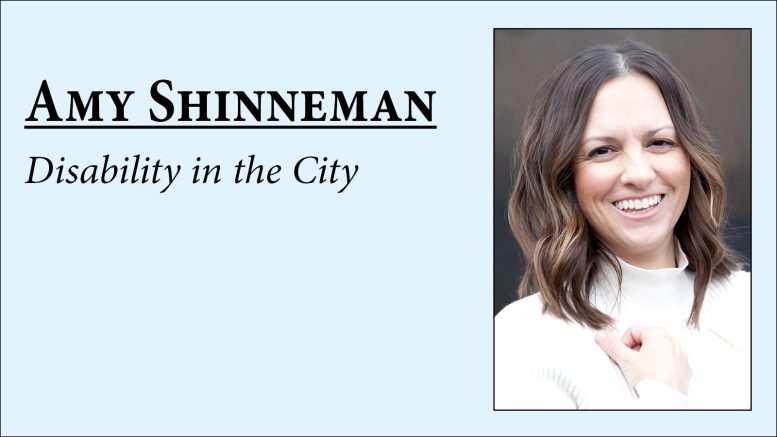
Amy Shinneman is a former National Ambassador for the Muscular Dystrophy Association, disability blogger, freelance writer, wife, and mom of two boys. She is the recipient of The Reporter’s Winter 2025 Ink-Stained Wretch award. You can find her blog at humblycourageous.org and reach her on Instagram @ashinneman.
Be the first to comment on "Anticipatory grief"