
“Mom, stay right here.”
That was my daughter’s request every time she climbed onto her bicycle.
For the longest time, learning to ride wasn’t really about learning to ride. It was about knowing I was there. She wanted my hand somewhere close – sometimes on her shoulder, sometimes near the back of the bike – as a quiet confirmation that if she wobbled, if she fell, if fear took over, I would be there to catch her.
And I was.
I walked beside her. I encouraged her. I reminded her to look ahead. I celebrated every few feet she managed without stopping. But eventually, I knew something had to change.
If I kept holding on, how would she ever discover that she could balance on her own?
So one day, I let go.
Not because she was suddenly fearless. Not because I knew she wouldn’t fall. I let go because I trusted that she was ready to try – and I trusted that I could still be there without holding her up.
I walked in front of her. She faced me, the fear, the uncertainty, and the road ahead. And then something magical happened.
“Mom! Look at me!”
She was riding. On her own.
“Mom, I can’t believe it! I’m going super fast!”
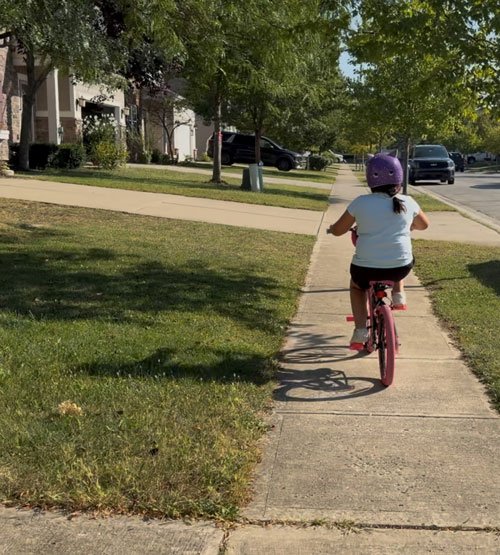
Photo provided by Pooja Thakkar
Her voice was filled with the kind of joy that only comes when we realize we are capable of something we once thought we couldn’t do.
I was still walking beside her. I had simply stopped holding her. Maybe that is the difference between helping someone and doing something for them.
Sometimes love means holding on. Sometimes love means letting go. Sometimes the greatest gift we can give someone is the confidence to know that even when our hand is no longer on their shoulder, we haven’t gone anywhere.
I think about that moment often when I think about community. We all have moments when we are learning to ride a new bicycle: a new job, a new city, a new culture, a loss, a transition, a difficult season or simply a version of ourselves we have never met before.
In those moments, we don’t always need someone to solve the problem. We may not need someone to take away the fear. We may simply need someone to say, “I see you. I understand. I’m right here.” What if that is belonging? Not removing someone’s struggle, but making sure they don’t have to face it alone. Not carrying someone across the finish line, but walking alongside them until they discover their own strength. Not having every answer in our backpack, but being willing to stay present while someone finds their own answers.
That day, my daughter didn’t need me to ride the bicycle for her. She needed to know I trusted her. Perhaps our communities need more of that kind of trust, too. We often think community is about showing up when someone needs help.
But perhaps community is also knowing when not to help. Knowing when to stop holding the bicycle and start walking beside it. Knowing when to stop giving answers and start giving space. Knowing when to say, “I won’t take away your fear, but you don’t have to face it alone.”
That is the kind of community I want to build: one where we trust people with their own journey while reminding them they don’t have to walk it alone.
So look around you. Who is learning to ride right now? Be the person who stays. Be the person who believes. Be the person who lets go without leaving. Then witness the magic when they look back and say, “Look at me. I’m doing it!”
Because sometimes, the most beautiful part of community isn’t being the one who teaches someone how to ride. It’s being there when they realize they already knew how.
Every story shared is belonging.
Pooja Thakkar is working to build cultural connections. You can read her column each week in the pages of The Reporter.
Be the first to comment on "Let go, but stay close"