
One year ago, President Trump initiated the U.S. withdrawal from the World Health Organization by executive order. It’s an irresponsible, uninformed, poorly thought-out, and dangerous decision.
In order to withdraw, WHO agreements plus federal law require one year’s advanced notice as well as fulfillment of outstanding financial obligations to the WHO; the withdrawal could now be finalized.
However, Trump refuses to pay the financial obligations but will proceed essentially unchallenged. He earlier ordered the Centers for Disease Control and Prevention to terminate all collaborations with the WHO and to cease WHO payments. He claims that our assessments are far out of proportion to those of other wealthy countries, particularly China. Indeed, the U.S. is the largest funder of the WHO (22 percent of total WHO assessments; China is 15 percent).
The WHO, with 196 member countries, is part of the United Nations. Among many essential health functions, it works to contain serious disease outbreaks, identify novel and emerging diseases, collaborate primarily with the U.S. to develop new vaccines (including seasonal influenza), and maintain high vaccination rates for serious diseases in underdeveloped countries. Consider its global role in the elimination of smallpox, the near elimination of polio, and the great progress in HIV/AIDS control. We should have continuing concerns about emerging diseases, including monkeypox and avian influenza and controlling Ebola, Zika, Dengue, influenza, Marburg virus, and others.
Aside from COVID-19 vaccine development, President Trump’s handling of the pandemic in the U.S. was slow and chaotic. Nonetheless, Trump has criticized the WHO for its handling of the pandemic, failure to institute reforms, and lack of independence from political influences. He has unfoundedly accused the WHO of conspiring with China to cover up the true origins of COVID-19.
Granted, the WHO has shortcomings. It’s imperfect and has been criticized in public health circles for inefficiencies, complicated bureaucracy, and, at times, relatively slow responses. But American and foreign public health officials worry that if the U.S. pulls out, there will be dire consequences to global health security. Disease surveillance, deployment of vaccines and medications, worldwide humanitarian relief, and responses to serious disease outbreaks and pandemics could be egregiously weakened.
Ending membership will isolate America. It will thwart participation in information sharing and coordination during health emergencies with foreign partners and hinder our own future pandemic planning.
We will lose a diplomatic entryway to engage countries with which we have poor political relationships. We will have no input and lose our role as the major influencer in international health policy and health regulation development, opening the door for China and Russia to have increasing influence. It appears Trump is myopically willing to throw the baby out with the bathwater. Withdrawal is not the answer.
There is no question that the WHO has saved millions of lives in America and worldwide since its creation in 1948. Notable public health experts have publicly called this decision “a catastrophic mistake” and “a grave strategic error” and warn us that “our public health agencies would be flying blind.” Lack of communication, not knowing what’s happening in the world, and no access to critical data are dangerous things.
Remember that in this age of global travel, a disease outbreak anywhere is a threat everywhere and can swiftly affect the U.S. Trump progressively isolates the U.S. by alienation of NATO allies with offensive rhetoric, tariffs, and withdrawal from other United Nations and international agreements.
One thing is clear: Isolationism doesn’t work for infectious diseases.
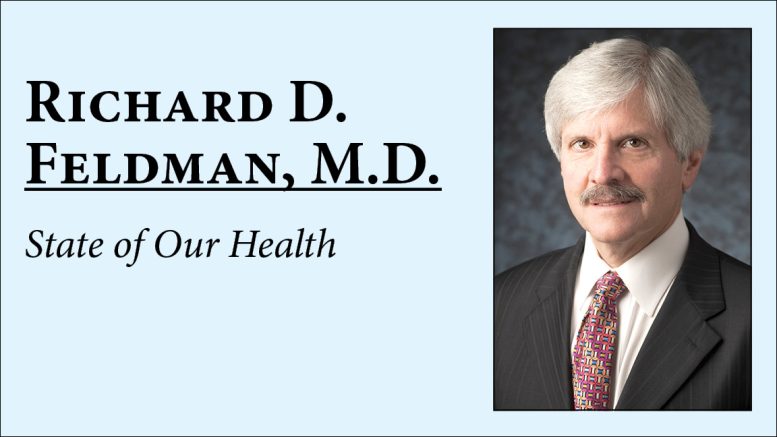
Richard D. Feldman, M.D. is an Indianapolis family physician and former Indiana State Health Commissioner who served in the administration of Governor Frank O’Bannon.