
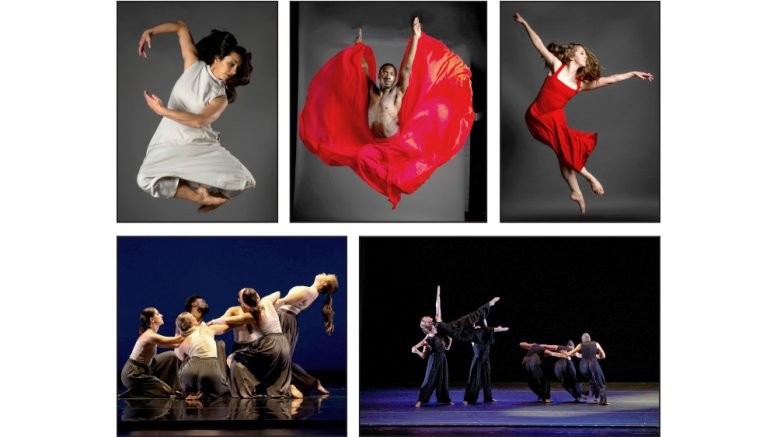
“Frequencies” brings Fishers’ only dance company to center stage
By WYNNE BRUBAKER
news@readthereporter.com
When seated in the audience of Pulse Dance Theater’s latest production, Frequencies, you may see yourself on stage. The collection of modern dance works in Frequencies portray the beautiful human moments that define us.
Pulse Dance Theater (PDT) will perform this galvanizing piece at Fishers Art Center Theater, 1 Municipal Drive, Fishers, on Sept. 26 and 27. Amanda Browning, founder and artistic director of PDT, told The Reporter about her experience creating a successful dance company and inspiring connection in Fishers through Frequencies.
“[Peforming Frequencies] is a great way to say that we’re here,” Browning said. “We are here in Fishers and we’re excited to perform for a theater in the community that we are in. In a way, it feels like an introductory performance because this will be the first time we’ve performed a big concert at Fishers Art Center.”
The production will feature an assortment of five modern and contemporary dance works by local choreographers, including Manuel Valdez, Mariel Greenlee-Lungu, Sarah Farnsley, Justin Sears, and Margo Korn along with Browning. Each choreographer has extensive experience in both producing and dancing, which contributes to their effectiveness in directing.
Since its creation, PDT has adopted a modern style of dance that is evident in Frequencies, and is what separates this company from others in Hamilton County.
“We are more of a modern or contemporary company,” Browning said. “While our dancers do have a lot of ballet technique, what we’re performing is not considered to be ballet. We’re very interested in exploring and communicating and telling stories about humanity and about the exchange between people. I would say the main difference is that [other dance companies] focus more on ballet, and we are more modern.”
Browning told The Reporter she was able to use her own dance experience to establish the contemporary essence of PDT.
“I was trained in classical ballet, and most of the dancers are, but I think we just all found a love of modern dance and of contemporary practice,” Browning said. “It definitely utilizes the ballet knowledge and vocabulary that’s living in our bodies. Our dancers speak the lines of a ballet dancer, but it is a different approach to how we create movement, to how we execute movement. It’s just a different kinetic vocabulary that we’re utilizing to communicate on stage. I think it becomes a very unique and visceral way of being able to communicate, whether we’re working in the studio or we’re actually performing, that communication is passed on to our audience.”
Browning used much of her own inspiration from dance to create PDT, even when the thought of starting a company seemed outlandish.
“I love to choreograph. I’ve been in the professional choreography world and do a lot of work with universities and colleges and guest choreography,” Browning said. “People would always ask, ‘Do you ever want to start your own company?’ and I would say, ‘No way, it’s so much work, and the financial side of it.’ Dance is already a very low-paid industry, but then to try to raise the funds to rent theaters and buy costumes and pay choreographers and then pay the dancers and lighting designers– it requires a lot of fundraising to make that happen, and that was something I was not interested in diving into.”
However, Browning’s passion for using dance and choreography to express ideas encouraged her to continue.
“I was very interested in oral tradition,” Browning said. “Stories, specifically the ancestral stories of family and grandparents, and how those stories are passed down from generation to generation. Not just stories, but all the things that we do with our hands and our bodies, like recipes that have been passed down, or craftsmanship that’s passed down generation to generation.”
Some parts of that generational knowledge are best expressed in dance.
“How that movement, that knowledge then becomes part of what’s known as genetic memory, like our body just inherently recognizes it because it’s been passed down via generation,” Browning said. “A culmination of my master’s work and that master’s thesis project was titled Through the Pulse of Memory, and it was a study on genetic memory and how people tell stories through oral tradition.”
After performing that dance production at the Indy Dance Festival, Browning selected the word “pulse” from the title, “Through the Pulse of Memory,” which led to the official creation of Pulse Dance. PDT was born to convey the importance of communication, and communication through dance remains in each performance.
“We didn’t really know where it was going at that point, we just thought ‘let’s just keep performing together,’” Browning said. “We enjoyed performing together and creating together. There’s a core group of us who had known each other professionally in the dance world for quite some time and had been dancing with each other. We wanted to keep dancing with each other. We applied for nonprofit status, and when we did that, we registered the name Pulse Dance Theater to take it from a project-based performing group to a full-season company. Our first season was a success. We had a lot of great experiences. Prior to us, Fishers did not have a professional dance company that could call Fishers its home.”
Besides Browning’s ambition and support from the original performers, the supportive culture of Fishers was central to the success of the group.
“I love Fishers. I think there’s something really special about it, and it’s growing,” Browning said. “I think within that growth, the performing arts is growing, and I do think it’s important for it to have that cultural identity of being able to host and house a professional dance company. [There is a] tremendous appreciation for the arts community, not just in Fishers, but in the greater Indianapolis area. There is a willingness for artists to want to help other artists be successful.”
Due to Fishers’ praise of arts communities, it is the perfect audience to interpret the meaning behind Frequencies.
“It’s always a goal of mine for the audience to see snippets of themselves in the dance works that are happening,” Browning said. “Maybe it’s in an emotion or a gesture or a relationship that they see on stage, or even just energy that they’re feeling with the music and the dance and the lights. I always want the audience to think, ‘Oh, that’s me.’”
To buy tickets to Frequencies, staging Sept. 26 and 27, go to PulseDanceTheater.com/events.
To find out more about Pulse Dance Theater, visit PulseDanceTheater.com. If you would like to donate or contribute in other ways to Pulse’s continued success, there are contact and donation links on the website.
This story was updated to correct spelling errors.
Be the first to comment on "The ‘Pulse’ of dance"