
For many years of my life, I paid a price to belong. I thought I needed to sacrifice my identity to belong in the world. To matter.
My internal dialog was a constant stream of worry about what was “wrong with me.” Over time that loop played simultaneously while I tried on the outside to pretend I was “normal” like I perceived my peers to be. I became a master multitasker at an early age.
I did an excellent job at it. As my friend said in my column last week, “you hid it so well.” Meaning my pain. My physical disability cannot be disguised.
It was my duty to hide it. I needed to protect my family from shame and ease their burden. Early on, I started to shoulder the burden, thinking that would make things better for them if I could act as “normal” as possible.
I was very aware of how my life was causing hardships to my family. They never told me that, I just knew. The surgeries, the therapies, the doctors all took valuable time and financial resources from our family.
It felt awful knowing that and not being able to fix it. The only thing that was happening were a lot of doctors taking a stab at trying to figure me out. To help me get better. Cutting, casting, bracing, rehabilitating, but none of it “fixed” me.
When the mocking started in school, I knew that my efforts to appear “normal” were not fooling everyone. The kids that bullied me knew. Everyone knew I was disabled, but that was not a word ever used to describe me.
Crippled, handicapped, and physically challenged were words that stung every time. I still cringe when others use those words to describe me. Doctors used the most clinical and ugly words to paint my portrait. I often felt like a freak leaving my testing and appointments.
My body was just a job to them, and it felt like I was more of an object rather than a human.
The words they used in their dictations were cold, void of any empathy. As I got older, I read their words from copies of the dictations we would get in the mail. I still have some of them, and it still hurts to read them.
I felt anything but human reading their medical terms. It made me loathe myself even more than I already did. It affected the little self-confidence I had and still does to this day.
They were doing their job, but the fallout fell solely on me. I did not know how to talk to anyone about it. I was too young to form it into words. That was a living hell.
My differences were an automatic separation from everyone else. My self-rejection was as harsh as any other rejection I may have received. When my friends would tell me they did not even see my disability, it baffled me.
Although that is what I was going for, the fact that they said that to me meant my efforts were working. How was I fooling them, but not the bullies? When they told me that, something about it did not feel right to me.
I told myself that my friends were protecting me by telling me that.
The ultimate goal when presented to me like a trophy, felt like a loss. Anytime we cover up our true selves, and pretend we are someone we are not, it feels wrong. Our souls know who we truly are.
You can only bind up your truth for so long before it forces itself to the surface.
I think back about that girl, and she feels like a completely different person from who I am today. Sometimes I miss her; she had a lot of fight.
If you have ever fought against your identity, you know how exhausting that is.
As a woman of faith, I struggle that I spent so much time running from who I was created to be. There is another part of me that thinks all that time spent hiding from myself was all part of the plan. The molding, the shaping.
I hope that someday my words will find someone who feels like they must live outside of themselves because they want to fit in.
Now I know I was not the only one carrying a heavy weight during that time. My young mind only saw my pain. I have learned that all along, there were people silently suffering right along with me.
It feels wonderful to have stepped into my identity, and to be so passionate about writing about it. It feels right, in this disabled body, just as I am. The struggles remain, but the burden is lighter, living out my truth.
“Find something that you are so passionate about that it saves your life.” – Wynonna Judd
Until next time …
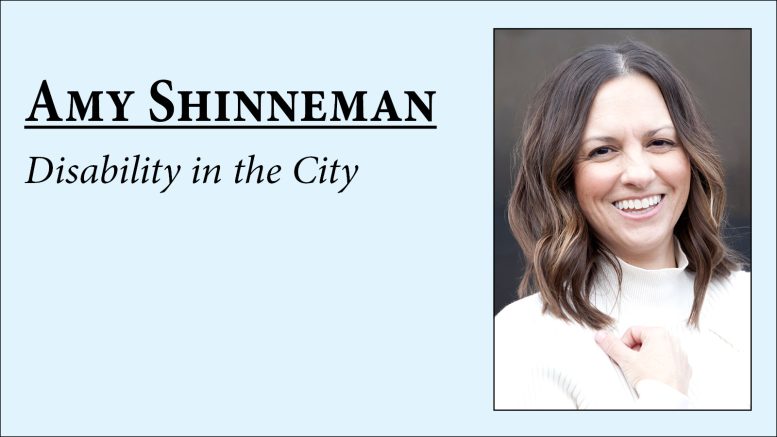
Amy Shinneman is a former National Ambassador for the Muscular Dystrophy Association, disability blogger, freelance writer, wife, and mom of two boys. She is the recipient of The Reporter’s Winter 2025 Ink-Stained Wretch award. You can find her blog at humblycourageous.org and reach her on Instagram @ashinneman.
Be the first to comment on "The price of belonging"