
I mentioned joining the Navy in last week’s column and was thanked for my service. So for Veteran’s Day, I’d like to write a little about my military experience.
In 1968, the USA was embroiled in the Vietnam War – an unwinnable war as we found out much later and after much loss of American lives. It was a scary time to be a young man without a deferment. I had just lost my student deferment in June of 1967. Near the end of that year, I received my draft notice in the mail. It hadn’t taken long for them to find me.
I had to make a decision – whether to be drafted for a two-year stint in the Army facing a possible tour in ‘Nam, or choose a four-year enlistment in one of the other services. I didn’t want to test the Army choice, so I walked into the Navy recruiting office and signed up for the longer stint – being guaranteed a position in Naval Air – I hoped to be an Air Traffic Controller and train for a job after my service time.
On Valentine’s Day 1968, I signed the blank check issued in my name valued up to and including my life. Anyone who joins does the same. It is a solid commitment. I promised to do everything they told me to do. And to defend my country. In exchange they would train me, feed me, house me, and pay me.
After boot camp at Great Lakes Training Center north of Chicago (what a cold place to be in February, March, and April for 11 weeks) and after two weeks at home on leave, I was sent to Naval Air Station Lakehurst, N.J., the same place where the Hindenburg had crashed in 1937. Here I attended Aerographer’s Mate school – AG school in Navy parlance. (I had failed one of the 10 or so eye tests they give you in order to qualify for AC school – my Air Traffic Controller hopes evaporated.)
AG school taught me about weather, weather observation taking, recording said obs and plotting weather maps from coded transmissions. It was very hot and the best thing about the posting was it was near the Jersey shore, so weekends could be by the water, and I met my first wife while I was there. (Another story for another time.)
My sea-duty deployment followed and my at-sea duty station was Guam. No ship, just a small eight-mile by four-mile island for 18 months. I was attached to the Joint Typhoon Warning Center, an Air Force unit. I know – doesn’t seem right. Sea duty with the Air Force. We kept watch for typhoons and issued warnings to the fleet, the force, and to populated areas.
By the end of my tour there, I was beginning to learn computer operations that predicted weather and was told I would be a computer operator in Monterey, Calif., after I went to Oceanographic School in Lakehurst. Again, a seafaring education for a land-based computer operator. Some of my Navy enlistment made little sense to me.
In Monterey, at the Fleet Numerical Weather Center, I ran the Research and Development computer, testing forecasting programs written by anxious programmers. Those were still the days of the punch-card: programs written one line at a time and entered on cards that were read into the computer, which happened to be – at that time – the fastest computer in the world, the CDC 6000.
I loved Monterey and went back to live there and go to college there after I was discharged – honorably, by the way.
When people thank me for serving my country, I accept it knowing that I was not a combatant, never a hero, never fired a shot. Our armed services are a network of dedicated and hardworking women and men who do a myriad of different tasks every day, all which contribute to the unbelievably complex job of protecting our nation. My jobs, which all provided weather alerts to the forces, were a small but vital part of that undertaking.
My military time was mostly well spent, I think. Mainly, for me personally, it was a transitional period from being a kid at home to becoming a young man in the wider world.
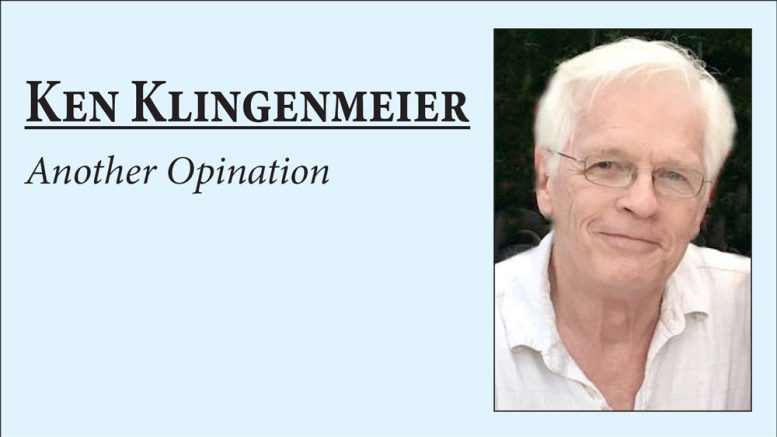
Ken Klingenmeier, a longtime reviewer of local theater productions, occasionally opines on other topics.
Be the first to comment on "A Veteran’s memories"