
School has begun. Teachers and students are getting into the rhythm of another school year. Reading. Writing. ‘Rithmetic. Robots?
One school district in Western New York State proposed a pilot program using a “humanoid robot” to assist in a classroom. Tremendous push-back from teachers and mothers and fathers as well as others in New York state put the entrance of the “robot” on hold. Would you want your child or grandchild to be “taught” by a robot?
What is the value of being taught by a human being? Isn’t it that a human can inspire? Can express empathy and compassion? Can “think on her or his feet” when confronted with an unexpected situation? Can teach what it means to fail and rise again? Can exhibit ethical behavior? Can change lives?
My final undergraduate education course “Philosophy of Education” required a paper on “My Philosophy of Education.” As I reflect on the purpose of education today and how it can cultivate civility, I first maintain that the example of teachers and administrators is paramount, but students can get involved as well. An elementary teacher in Minnesota told of a school “Unity Day” that emphasized values that support civility. A “Kindness Quilt” is assembled by students who use multi-colored paper squares to provide actions that can help instill an atmosphere of kindness in the school. The finished quilt is then put on display for all to see.
Having taught English for 35 years, I recognize how reading, writing, and literature can provide a foundation for nurturing civility. Understanding as well as critically assessing what is read is vital. Recognizing logical fallacies like “false cause” and “generalization” that oversimplify a complex issue can give students a reasonable defense of an issue. Reading also opens the door to different points of view on a subject, perhaps even from a different cultural perspective.
Writing requires thinking well. Writing in a journal slows students down so they may reflect. They can explore their own thoughts and feelings to better understand their values. Students can avoid logical fallacies like those mentioned above which oversimplify a problem. Learning to write an argument or civil discourse paper gives students the tools to engage thoughtfully with those having opposing viewpoints.
Literature provides an opportunity for students to use their imaginations in visualizing characters and scenes which I believe also helps with problem solving, i.e. “thinking outside the box.” Reading literature reveals that human nature does not change from age to age or from place to place or one culture to another. Knowing this promotes better communication.
Sometimes an education comes from someone outside academia.
Dolly Parton, country music songwriter/singer and philanthropist who left us on Aug. 25, was such a person. It seemed that she routinely treated people with consideration and civility. “Parton’s legacy breaking political divide” was The Indianapolis Star headline for an article (Aug. 27, 2026) that featured political figures from both major parties paying tribute to the country music legend. Sen. Susan Collins used these words: “Through the Dollywood Foundation and her global Imagination Library, Dolly gave free books to children around the world, sparking a lifelong love of reading. Her legacy will live on in the classrooms and communities she uplifted and the beautiful music she created.”
Perhaps the most important lesson Dolly Parton teaches us is to love people and use our lives to uplift others.
Robots cannot leave a legacy. We can. We can leave a legacy that can impact others for good, creating a civil society where, ideally, all can thrive.
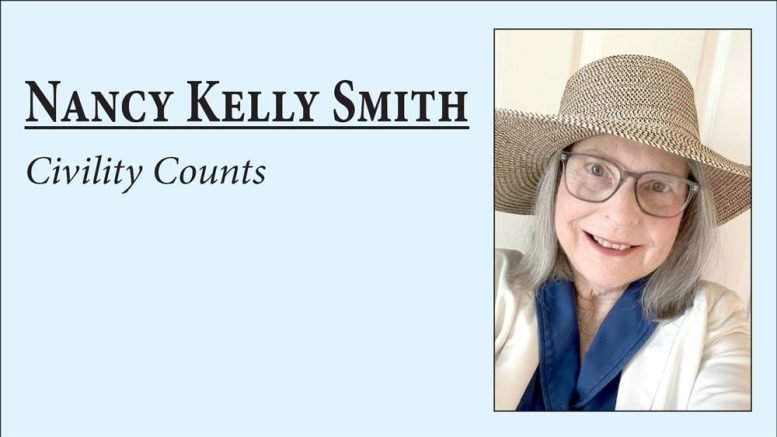
Nancy Kelly Smith is a retired English professor and published author. She is also an Ambassador for the national civility organization Civic Renaissance. Learn more at civic-renaissance.com.
Be the first to comment on "ABCs: Reflections on Academics, Bots & Civility"