

By GLENN DOBBS
A Seat on the Aisle
“… the purpose of playing, whose end, both at the first and now, was and is, to hold, as ’twere, the mirror up to nature” – Hamlet, Act 3 Scene 2
I have sat through many meetings regarding play planning. In today’s climate of tribal warfare there is often a push to go for the “safe choice.” In the desire to boost ticket sales, companies are often compelled to avoid controversy and try not to antagonize their audience base or patrons. “People want to be entertained; they don’t want to be forced to think” is a common refrain.
Yet artists play a role in society that is crucial. By exploring challenging stories, they expose injustice, reimagine identity and values, disrupt tradition, and ultimately create space for new ideas. By approaching these difficult stories, they provoke change and ultimately change our culture for the better. A play can hold “… a mirror up to nature” and show us the sublime and the horror of our world. Sometimes we do not like what we see.
Theatre artists tell these stories because it is their calling in life. If not them, then who?
It is in this vein that Carmel Community Players presents American Son by Christopher Demos-Brown at the Switch Theatre. American Son first premiered in January 2016 in Massachusetts. The production found an advocate in the actor Kerry Washington who took it to Broadway and later a Netflix special.
American Son tells the story of an African American mother of an 18-year-old son who has had an unspecified altercation with the police. We find her in a South Florida police station waiting for any information on a rainy night. She is soon joined by her ex-husband, an FBI agent, as they try to pry information from a reticent junior police officer. Something has happened, but we do not know what, and this mystery drives the terror of the play. In the course of a tense dark 90 minutes, we must endure with this family an excruciating crucible of anxiety.
The play asks a difficult question. Would this story be different if the missing boy was white? The answer is unequivocally yes. If you think otherwise, you are seriously deluded.
Ms. Zarah Shejule inhabits the lead role as the anguished mother, Kendra Ellis-Connor, searching for answers about her missing son. Ms. Shejule brings fierce anguish and towering anger to bear as she is increasingly thwarted by the obtuse bureaucracy of a local police department. She is faced with a wretched situation and despite her character’s education and social status – she is a college PhD professor of psychology – she can do little more than fling her body against a stone wall of silence. I was not familiar with Ms. Shejule’s work before to my detriment. She is a talented actress faced with a mountain of a role. She succeeds in summiting the peak admirably.
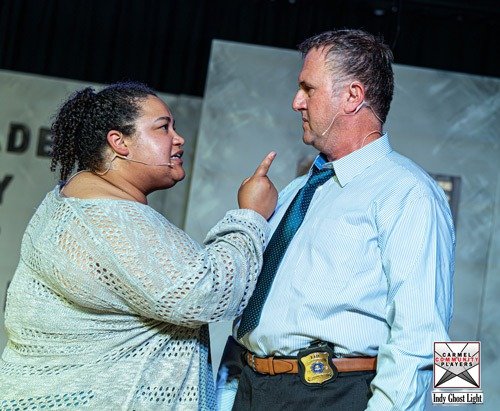
Kendra Ellis-Connor (Zarah Shejule) confronts her ex-husband Scott Connor (Earl Campbell). (Photo by Rob Slaven / IndyGhostLight.com)
I am familiar though with Earl Campbell. Mr. Campbell has been a stalwart talent for many years here in the theatre community. He plays the role of Ms. Shejule’s estranged husband Scott Connor, who arrives at the police station to assist in finding the truth to what happened to their son. Ms. Shejule’s character is African American and Mr. Campbell’s is white. Their mixed marriage adds to the dramatic tension of the story and serves as a foil to discuss issues of race and policing in today’s America. Campbell is an apt foil for the volcanic emotions for his ex-wife. His work here is complex. He must juggle his feelings for his ex-wife, his anguish over his missing son, and trying to defend his own existence of being a police officer in a white world. This is no easy task. Mr. Campbell, as is often the case, triumphs, in the role. He brings gravitas, power, and insecurity all at the same time – an outstanding showcase.
The cast is rounded out by Joshua Matasovsky and Bryan G. Ball. Mr. Matasovsky portrays Officer Paul Larkin, the earnest yet casually racist junior police officer who is on duty that evening at the station. He is the target of much of Ms. Shejule’s fire as the evening progresses. His often-hapless attempts at empathy also serve as the play’s rare moments of blessed comic relief. Despite his obvious underlying racist beliefs, you want to like this character. The tension in the play is so great you will seek any port in the coming storm. Matasovsky does a good job here and I enjoyed the moments he was on stage.
Bryan G. Bell arrives late in the show as the supervising police lieutenant, Lieutenant John Stokes. He approaches the role with authority and swagger that attests to years on the force. Such long service must pound on your soul and push out empathy over time, leaving only chronic anger. Bell is a force of nature as he has to deal with two desperate and hostile parents and a junior police officer too green to be of any real use.
The play is directed by Bradley Allan Lowe. I applaud him for having the courage to present a potentially divisive play in today’s poisonous political discourse. By depending on the sympathetic characters to tell the story of one rainy night at a police station, he allows the audience to see what is happening across our tortured country every day. The pacing, blocking, and design of this claustrophobic show builds real tension and offers the audience no rest. You want to look away. Mr. Lowe will not let you.
If I have a criticism of the production it lies with the playwright, not this talented cast and crew. Christopher Demos-Brown, who interestingly is white, has used the story to serve as a platform to share his views on a subject filled with landmines. As such, he has overloaded several parts in the play with monologues that drift away from the characters and feel more polemic. The audience is trapped in the waiting room receiving a lecture better suited for an activist rally than something a real person might say. As an audience member, you desperately want to feel empathy for the family’s story. Instead, some of the characters speeches just leave you with a sense of being beaten down and not knowing how to feel. It is rather like bobbing for apples in a bowl full of knives.
I have to be honest; this is a difficult play to watch. With the nightly news constantly filled with stories of brutality, it is difficult to be confronted so directly. I think that is the point. This production does not want to leave you with an escape. It refuses to let you off the hook. And for this reason, American Son is an important and necessary work.
In 1892 a Baptist minister and Christian Socialist named Francis Bellamy wanted to write something in honor of the 400th anniversary of the Christopher Columbus voyage to America. It was called “The Bellamy Salute.” He would write, “I wanted to inoculate both immigrants, the disposed, and native-born Americans to rally around our national symbol, the flag.” He wanted to celebrate our common humanity.
“The Bellamy Salute” would later be renamed to the “Pledge of Allegiance.” The last line of that well-known promise is “… with liberty and justice for all.”
American Son tells us we are not there yet.
Bottom Line: A searing, challenging evening of provocative drama well performed. I encourage you to see this show and bring a friend. Talk about your feelings afterwards because you will have them. We must talk with each other. Don’t simply turn the channel the next time you see a story like this on the news. Instead, think about the families in that dark waiting room waiting to hear their news.
Read more great play reviews from A Seat on the Aisle at asota.wordpress.com.