
As an ambulatory wheelchair user, I am constantly brainstorming ways to make my home more accessible. I want to live in a space that does not feel stressful.
Creating a space that works for both walking and using my wheelchair is a little bit tricky. Thorough-out my days when I am at home, I am constantly switching from walking to needing my wheelchair. My strength fluctuates a lot during the day.
Part of me wants to walk as much as I can since I am fortunate to still have that ability, but I also worry about my safety, and it is getting harder each day it seems. That is life with a progressive muscle disease. It is a double-edged sword.
Each day is different, but my desire for independence stays the same.
If my husband is home, I do not mind asking for help reaching things or whatever it may be.
When I am home alone, I need to be able to access things on my own. One of the things my wheelchair has helped me with the most is carrying things. Balancing things on my lap and taking them from room to room requires practice and patience.
The sound of something falling off my lap can be infuriating. It requires patience and practice to not get flustered by every little obstacle. That has been the hardest thing for me since getting my custom wheelchair three years ago. Managing frustration, while learning a new way of life.
The number of micro-obstacles in my day is overwhelming. I tried explaining this to someone recently, and I could tell that it was not received in the way I wanted it to be. But how could it be if the person has not dealt with it?
I remember when my aunt would visit when I was a little girl. She was in a wheelchair, as she was paralyzed and could not use her legs. I silently watched her, wondering how she made things look so easy, when I knew they were not.
Even though she was not in her own space, she still cheerfully helped my mom around the kitchen preparing meals and adapting to our kitchen. She did not miss a beat when mixing something. She put the bowl on her lap and mixed away.
I was fascinated by her confidence. She was one of the few disabled people who I knew as a little girl. I think of her often when I am cooking.
We truly never know the impact we have on others by just living out our lives. Knowing her, made a lasting impact on my life and carried me through times of sorrow and loneliness.
She also has a daughter, and I would watch how she would climb onto her lap. They had an unspoken rhythm, just like the one I have created with my own family. Her husband, my dad’s brother, was so good at helping her, just like my husband is with me. They were a wonderful team and admired by many.
Having a partner who is open to any modifications that I need to make is key. Most of the things that I need to adjust to make more accessible for me, do not negatively affect him. It is a space that works for our family.
We were mindful when we built our home more than 20 years ago, that we did not want a lot of stairs to get in the house and that we needed everything to be on one level. I am glad we thought ahead for the structural changes that would be harder and more costly to make now.
I am brainstorming ideas to make my kitchen even more accessible, to continue to allow me to cook from my wheelchair because that is something I love to do.
I have learned to enjoy the challenge of producing ways to make our home functional. It allows me the independence I deserve to enjoy for as long as I can.
Until next time …
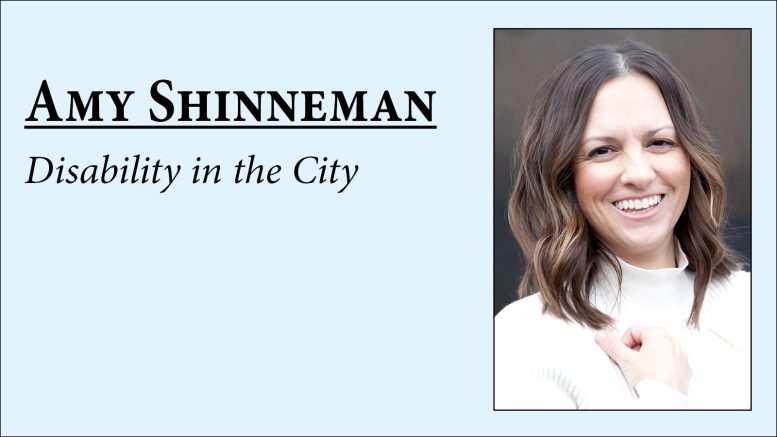
Amy Shinneman is a former National Ambassador for the Muscular Dystrophy Association, disability blogger, freelance writer, wife, and mom of two boys. She is the recipient of The Reporter’s Winter 2025 Ink-Stained Wretch award. You can find her blog at humblycourageous.org and reach her on Instagram @ashinneman.
Be the first to comment on "Creating an independent space"