
Submitted by Michael Schramm
Rotary Club of Westfield
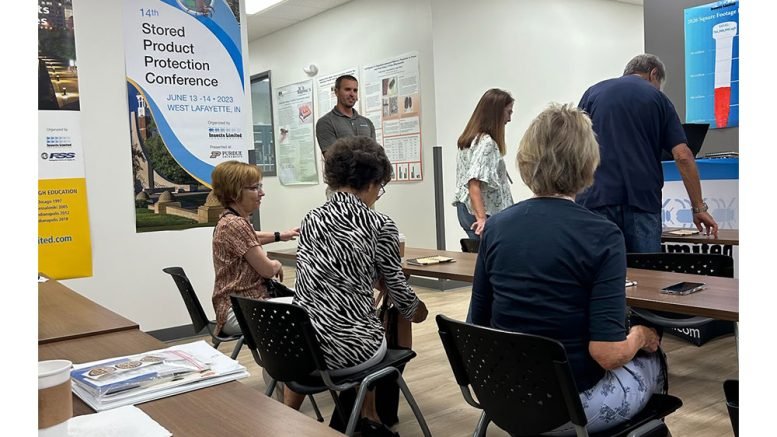
The Rotary Club of Westfield recently had the unique opportunity to visit Insects Limited, a globally recognized leader in integrated pest management and pheromone monitoring, during a special meeting hosted by CEO Tom Mueller at the company’s state-of-the-art Westfield headquarters at 20386 Commerce Park Drive.
Mueller shared the remarkable story of the family-owned business, which was founded by his father, Dave Mueller, in 1981 in a garage. What began as a small startup has grown into two successful companies: Insects Limited, which focuses on integrated pest management (IPM) and pheromone monitoring for stored product pests; and FSS, which provides pest management services. After expanding from a garage to an office building and later to a large log cabin in Westfield, the company moved into its impressive new facility just three years ago.
Throughout the presentation, Mueller introduced Rotarians to the fascinating and often unseen world of stored product insects. He explained how insects can contaminate food products at various points throughout the supply chain and demonstrated how Insects Limited studies insect behavior, habitats, and communication to develop environmentally friendly monitoring solutions.
One memorable demonstration featured a jar containing 100 rice weevils living in rice for more than 100 days, illustrating how quickly infestations can develop. Mueller explained that rather than relying solely on pesticides, the company uses synthetic pheromones that mimic the natural chemical signals insects use to communicate and reproduce. These pheromones attract insects to monitoring traps, allowing businesses to detect problems early before infestations become widespread.
The company has expanded beyond the food industry into manufacturing and cultural preservation. Mueller said that more than 250 museums around the world use Insects Limited’s pheromone products to protect valuable collections from destructive clothing moths and other pests. He also noted that pests cost the food industry more than $9 billion annually, making early detection and monitoring critical.
Following the presentation, members toured the company’s research and development laboratories and manufacturing facility. During the tour, Rotarians met team members Sam and James, who demonstrated the development of the company’s hand-crafted “Bullet Lure” technology. Using advanced research, specialized materials, and even 3D printing, the team creates custom pheromone lures designed for specific insect species. Mueller explained that some pheromone formulas require years of research and refinement, with one product taking 15 years to perfect. Today, Insects Limited manufactures monitoring products for approximately 35 different insect species.
The group also learned how the company partners with major manufacturers to improve product packaging and reduce pest intrusion. One ongoing project involves testing pet food packaging against insect infestations, and Mueller shared that future packaging for one of the largest pet food manufacturers in the world will incorporate recommendations developed through Insects Limited’s research.
Rotarians were equally impressed by the company’s commitment to innovation and operational excellence. Mueller described how the business uses the Entrepreneurial Operating System (EOS), inspired by the book Traction, to guide its core values, strategic planning, and employee accountability.
The tour concluded in the warehouse and packaging areas, where Warehouse Manager Cindy explained the careful inventory management process required to maintain the freshness and effectiveness of pheromone products. Members observed specialized packaging equipment and learned how barrier materials help preserve the products by preventing pheromones from escaping before use. Orders for nationally recognized companies, including one of the largest pest control companies in the world, were being prepared during the visit.
As a parting gift, Mueller and his team presented each Rotarian with a fruit fly monitoring trap, providing members with a practical example of the company’s innovative work.
The Rotary Club of Westfield left inspired by the world-class scientific research taking place in its own community and with a greater appreciation for the work being done to protect food supplies, museums, and manufacturing facilities around the globe.
To learn more about Insects Limited, visit insectslimited.com.
To learn more about the Rotary Club of Westfield and join us for future meetings and community activities, visit westfieldrotaryin.com.