
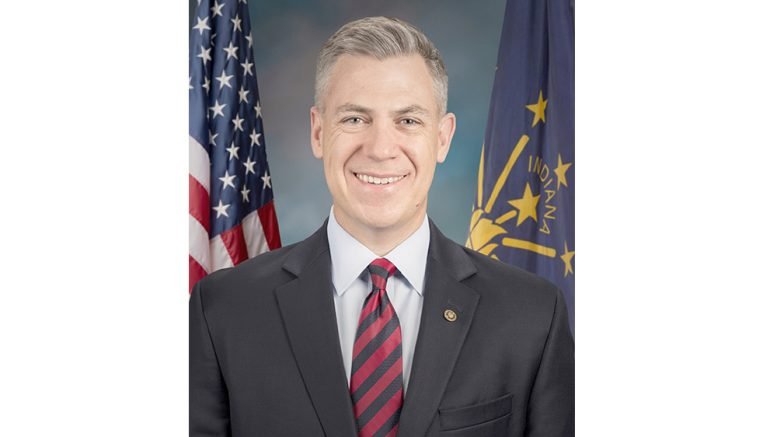
Submitted by Office of U.S. Senator Jim Banks
On Thursday, July 23, U.S. Senators Jim Banks (R-Ind.) and Adam Schiff (D-Calif.) introduced the bipartisan Collaboration on Adversarial Threats and Security Risks Act, legislation to help American artificial intelligence companies work together to defend against espionage by Communist China and other serious national security threats.
As American companies race to advance Artificial Intelligence systems, foreign adversaries are increasingly attempting to steal U.S. technology through cyber-attacks, model theft, and ‘distillation’ attacks that replicate advanced AI models at a fraction of the cost. While existing laws allow companies to share information about cyber threats, there is no comparable legal framework allowing AI developers to coordinate against emerging AI-specific security risks.
The Collaboration on Adversarial Threats and Security Risks Act creates a narrowly tailored antitrust safe harbor allowing AI companies to share threat information and coordinate defensive measures in good faith to address defined national security risks while preserving existing antitrust protections against price-fixing, monopolization, and other anticompetitive conduct.
“The AI race is one that America can’t afford to lose,” Sen. Banks said. “Communist China is working every day to steal our technology and close the gap with the United States. American AI companies must be able to collaboratively defend against our adversaries. The bill gives them the tools to protect America’s technological edge and helps ensure we maintain our competitive edge.”
Key provisions of the bill
The legislation allows AI developers to collaborate to identify, assess, prevent, investigate, and mitigate defined AI security risks including:
- Preventing the theft, distillation, weaponization, or misuse of advanced American AI models by foreign adversaries.
- Sharing information on cybersecurity vulnerabilities, unauthorized access, and attacks targeting frontier AI systems.
- Addressing AI-enabled chemical, biological, radiological, nuclear, and offensive cyber threats.
- Coordinating responses to risks involving loss of operational control over advanced AI systems.
The legislation includes strict guardrails to ensure these protections cannot be used to undermine competition. It explicitly prohibits price-fixing, market allocation, monopolization, boycotts, or any other anticompetitive conduct unrelated to legitimate AI security and national security threats.
Background
The legislation responds to growing evidence that foreign adversaries are conducting industrial-scale efforts to steal America’s most advanced AI capabilities. According to public reports, Chinese actors have used tens of thousands of fraudulent accounts to extract millions of interactions from leading U.S. AI systems in an effort to replicate frontier models. The White House has also warned that China is conducting deliberate campaigns to distill advanced American AI systems.