
Uttarayan – Makar Sankranti – was never just another festival on the calendar while growing up in India. It was a season of anticipation, a feeling that arrived weeks before the actual day. Long before the sun changed its course, our minds were already soaring with the kites.
Preparations began quietly at first. Shops would suddenly bloom with bright paper wings and spools of manjha, the glass-coated string that promised victory in the sky. Choosing the right kite was serious business – lightweight yet strong, colorful yet fierce. We tested strings between fingers, compared reels with friends, and made secret plans about whose kite would rule the neighborhood skyline.
But alongside the fun lived something deeper. In my family, Uttarayan always began with a visit to the temple. We went not only to pray but to give. Food donations were an essential part of the ritual – grains, meals, sweets – offered for those who had less than us. The festival celebrates harvest and abundance, and with abundance comes responsibility. I grew up learning that joy multiplies only when shared, that a celebration is incomplete if it ends at our own doorstep.
Those mornings taught me to think beyond our circle – to extend hands toward strangers and neighbors, to recognize that community is larger than family. Giving food in the name of the festival was a quiet lesson in compassion. Only after that act of gratitude did the day truly feel ready to begin.
And then came the terraces.
Rooftops woke up before the streets did. Goggles, finger covers, hats, and a few bandages “just in case” became our festival uniform. From every corner came voices – someone cheering a victory, someone groaning over a cut string, someone yelling the famous cry, “Kai Po Che!”
The sky turned into a moving rainbow. Millions of kites danced at once – red, yellow, blue – each carrying the pride of the person holding its string. There was playful rivalry everywhere, yet the same rivals would sit together minutes later, sharing chikki, til laddoos, and seasonal undhiyu.
Undhiyu was the true flavor of Uttarayan in our home – a rich mixed-vegetable curry slow-cooked with patience and love. My mom and my aunt would start preparing it early, the aroma floating up to the terrace and mixing with the crisp winter air. Even today I can almost taste it. Just yesterday I found freshly made undhiyu at Patel Brothers here in Indiana, a store that has carried our food legacy for more than 50 years. Finding it felt like discovering a small piece of home.
For years I wondered if my children would ever experience the Uttarayan I knew. Then, after a long wait, something beautiful happened. Last year, for the first time, the Hindu Temple of Central Indiana on Post Road celebrated Uttarayan here in April, when the weather was kinder and the winds perfect for kites. Standing outside with friends in Indianapolis, strings in our hands and laughter in the air, I felt my childhood return. I was no longer only remembering the festival – I was living it again, this time on American soil and with a new community.
Living far from India, I realize what I miss most is not just the kites but the terrace life – the late-night movies, endless games, sleepovers under open skies, and my favorite ritual of star gazing. Those terraces taught us how to belong to a neighborhood, how to celebrate without invitations, how to be together without plans.
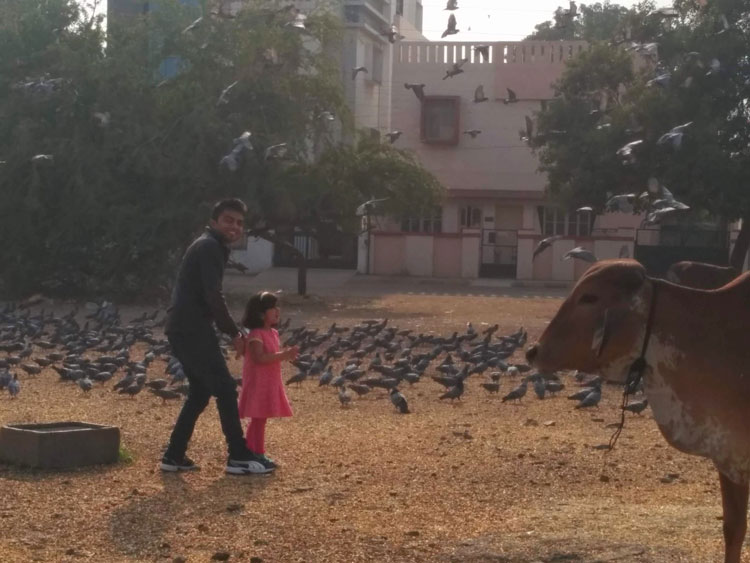
Our columnist’s younger brother and her older daughter offer food donations to animals in 2015 in India. (Photo provided by Pooja Thakkar)
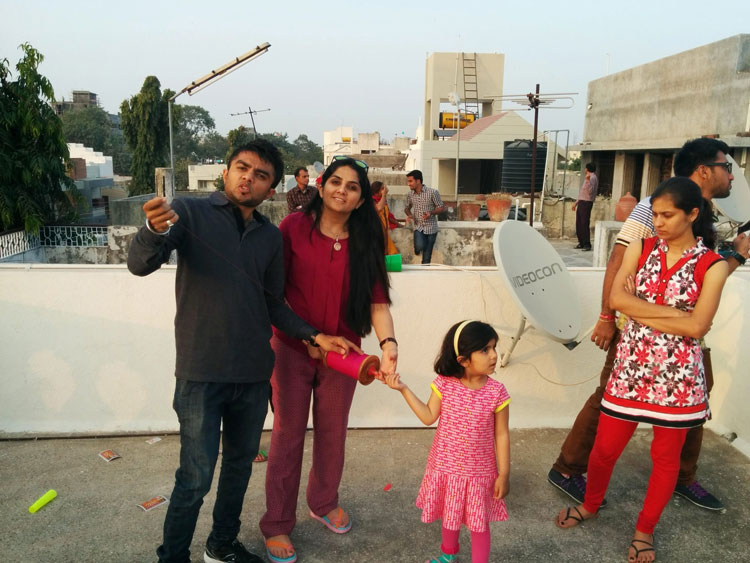
Photo provided by Pooja Thakkar
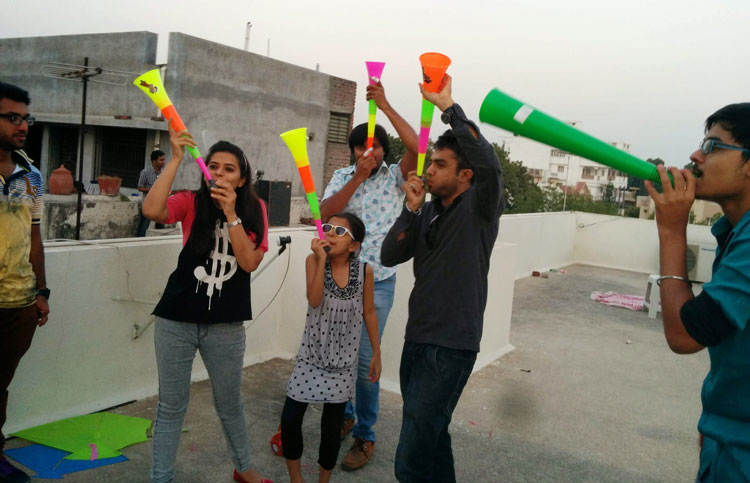
The last time our columnist did Uttarayan when she was back home in India. (Photo provided by Pooja Thakkar)
So when someone asks, “Do you still miss India?” my answer is simple. I miss Uttarayan mornings that smelled of sesame and jaggery, the thrill of a kite duel, the quiet joy of giving before celebrating – and now I am grateful to recreate a piece of it here with my family.
Uttarayan reminds me that festivals are not only about looking up at colorful skies but also about looking around at the people beside us. Gratitude, generosity, food, and fun – together they form the real string that holds a community.
I’m sharing a photo memory from last year’s celebration with my family – a small proof that traditions, like kites, can travel across oceans and still find the wind.
Pooja Thakkar is working to build connections through cuisine. You can read her column each week in the pages of The Reporter.
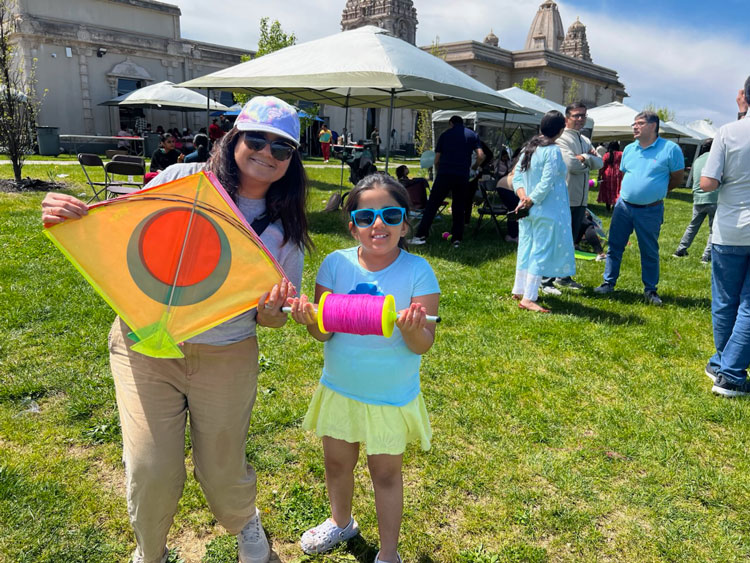
Our columnist and her younger daughter at the Indy Hindu Temple in April 2025. (Photo provided by Pooja Thakkar)