

As I approach my 77th birthday, my medical procedures Bingo card is pretty full. All the usual stuff has been “daubed” – the X-rays, scans of various sorts, checks for this or that. Various conditions I’ve had are marked off, and of course the usual ectomies and oscopies as well. I even got to mark off a mammogram. (See “Don’t wait until it’s too late . . . go get that man-o-gram, guys!” 10/26/23)
One that hadn’t been marked off until recently is prostate cancer-related stuff. That’s a very important one. Men, especially men my age, know only too well the slightly invasive “now, drop your shorts and bend over the exam table” procedure that we go through during our regular physical exams. It’s short, and never as bad as imagined.
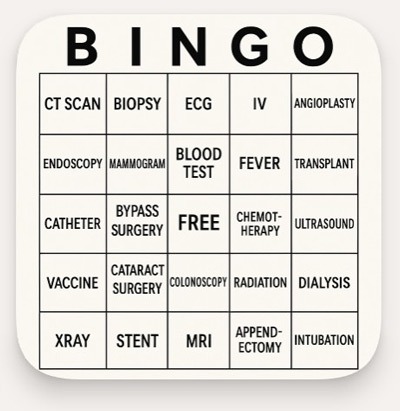
Graphic provided
Nowadays this is coupled with a PSA test which looks at the prostate specific antigen level. It’s a part of the complete blood test and the result can indicate a presence of cancer in a typical male. Anything over a 4 gets the doctors’ attention and mine was increasing over about 18 months from 4.2 up to 4.77.
Those results triggered a visit to a urology clinic, which led to an MRI scan of the prostate area. The readings of the MRI showed three areas of interest which were scored as to likelihood of cancerous activity. I had a five and 2 threes. (I was hoping for a full house, but no luck.) The five drew more attention than the others and it was suggested I have a biopsy of my prostate. Further appointments were scheduled. (Note: of special interest, the MRI showed that I had a prostate measuring 200 cc, whereas a normal size is 20 to 30 cc. “It’s ginormous!” my urologist exclaimed.)
Anytime I have an upcoming medical procedure or test related to my questionable health factors, I go online and try to educate myself about it. AI has been especially succinct and helpful about any questions I may have. The info I got about a prostate biopsy was slightly alarming.
Naturally this procedure is a bit more invasive than the exam at my typical physical appointment. Pictures I found showed a tool that looked a lot like a curling iron and it was said that this tool would grab small pieces of lesion material – at least 12 samples would be taken. Actually nothing very visually graphic was offered, unlike my heart ablation explorations where I found a step-by-step live on-the-scene video of an actual procedure. The lack of any honest showing of a biopsy made for a small amount of anxiety.
I was also told that I would have the opportunity to take a Valium before the procedure if I wished. This too struck me as quite interesting. If a Valium might be necessary to make it through, what are we actually talking about happening here?
The big day approached with my having to quit several of my medications for a week in advance preparation. I showed up at the clinic with a fairly calm continence, so much so that the staff felt I didn’t need a Valium and I would do just fine. Easy for them to say.
After donning a gown, I was led into the small office where the machinery was waiting. I had a seat and Dr. N came in to brief me on what to expect. One of the first things he said was, “You have a ginormous prostate.” (Obviously “ginormous” is a much-used clinical term in urology.) “What that means,” he continued, “is that there is very little likelihood of there being any cancer with the PSA score you had. (As a resident, Dr. N had been involved in a study of men with larger prostates and the ramifications thereof.)
So, with that in mind, we did the biopsy procedure anyway.
Truthfully, it wasn’t that bad. The area was numbed with a quick painless injection at the site. The tool resulted in very minor discomfort. And the overall feeling was, to me, similar to the vibration from a hand-squeezed staple gun like the one I have in my workshop.
It all took about 15 minutes. The results of some bleeding in urination were as predicted and by the day after, all things were very much back to normal.
I saw the results which come through the online portal that the clinic offered – all clear except for one area which was marked ASAP – for Atypical Small Acinar Proliferation. This indicates a small cluster of prostate glands which appears suspicious for cancer but not definitively cancerous. A further test by the lab came out negative. So I am prostate cancer-free, as predicted by Dr. N.
What I wish to get across in this dissertation is mostly that there is really nothing to fear about any of the procedures and testing that one may go through in this area. Prostate cancer is the second highest cause of death in American males, so doing the tests and finding any problems in their early stages can save your life.
Ken Klingenmeier is known in the pages of The Reporter for his reviews of local theater productions in the Greater Indianapolis area, which you can read on his blog, A Seat on the Aisle. He also occasionally opines on other topics.